


By Anelia K. Dimitrova
Should Cedar Falls allow future data centers and cryptocurrency mining operations in town?
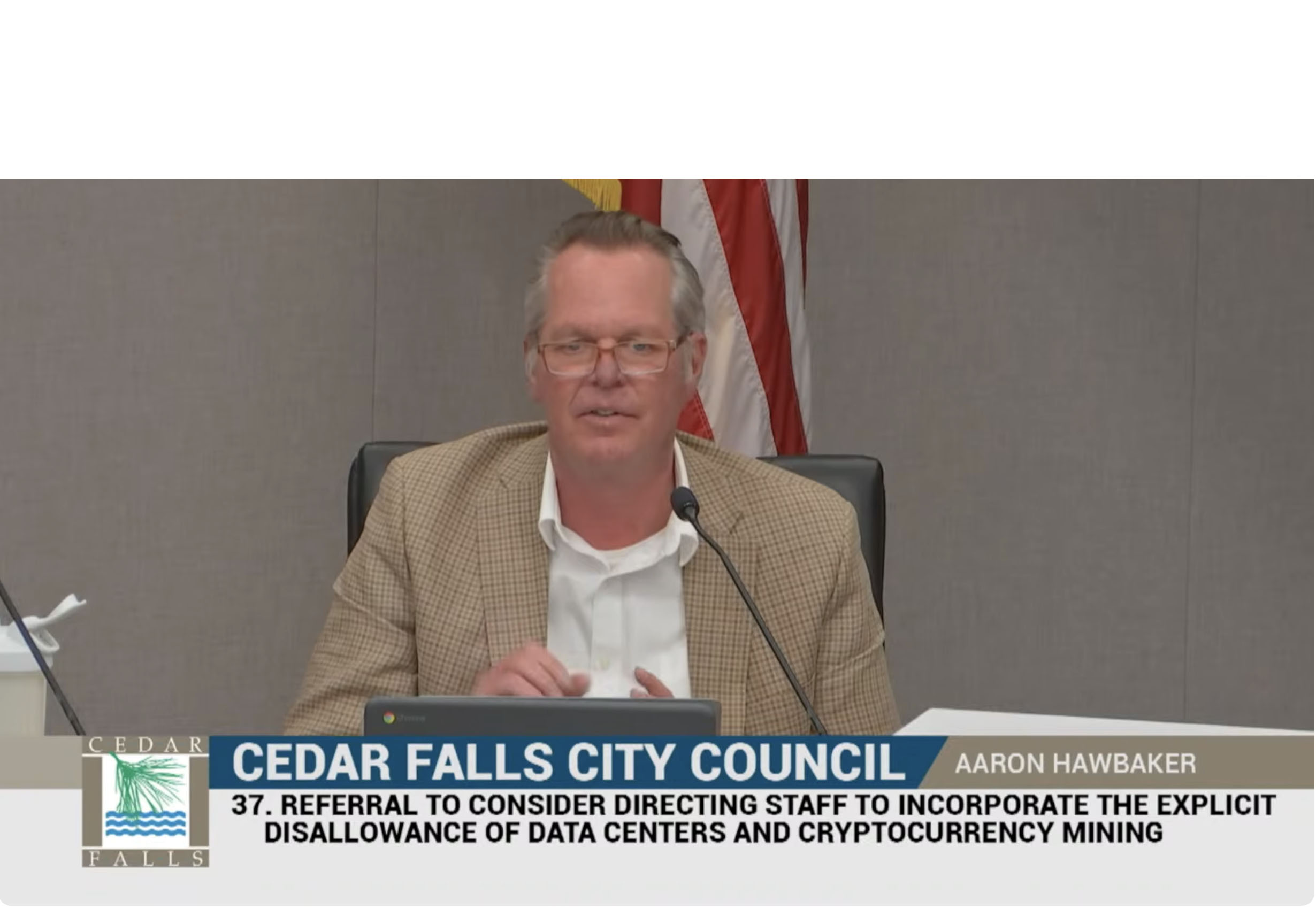
That policy question was posed in the council chambers and in a formal way on May 4, when Councilman Aaron Hawbaker, who represents Ward 4, submitted a referral to the mayor, asking that city staff be directed to craft an ordinance around the “exclusion of data centers and cryptomining facilities” in the zoning code of Cedar Falls.
This was the first time a council person stepped publicly into the heated public debate about the future of such facilities in town. So far, that discussion has been unfolding at the P&Z meetings since at least March 25, when a draft zoning code regulating such facilities was first presented to the public.
In essence, on Monday, the seven-member council effectively hit the pause button on future crypto mining and data center facilities in town for now. After a brief discussion and feedback from the audience, the council unanimously okayed the referral, placing the issue into the hands of city staff and the two attorneys currently serving the city (a new hire takes over the city’s legal matters with the impending retirement of city attorney Kevin Rogers.)
The council is to expect an update from city staff in 60 days, as per the discussion at the meeting.
A public hearing will be held during the council meeting on May 18 at the council chambers regarding the issue.
How did the issue evolve
At the March 25 P&Z meeting, a consultant hired by the city presented a draft of a zoning code that spells out what rules and restrictions prospective cryptomining operations should have to meet if they were to be allowed.
The need for that draft emerged after a cryptomining company in town called Simple Mining approached the city with an expansion proposal.
Since currently Cedar Falls does not have a zoning code for cryptocurrency mining or data centers, such are not allowed in town. Yet, three small operations, whose existence was permitted at a time when little was known about cryptocurrency mining, have been mining in town in the past several years.
During the March 25 meeting, a lot of questions were asked by community members, who were deeply concerned about environmental and quality-of-life issues if the facilities were to be allowed.
CFU leaders made their case for the building of a new plant for which the utility had requested a zoning change from light industrial to heavy industrial use. In the same meeting, a representative of Simple Mining, the cryptocurrency mining company headquartered in Cedar Falls, emphasized the company’s local roots, its contribution to the revenue stream of the city, and its creation of jobs in town. He also said that their operations are curtailable, meaning the utility can cut them off in peak times, and noted that they use power at night when demand is low.
The questions from worried community members raised in that meeting prompted a swift change prior to the next scheduled meeting for April 22.
The city and the utility amended their original request for the type of rezoning for the new plant proposed by CFU. Instead of heavy industrial use, which was their initial request, they changed their ask to rezoning of the land to public use. This means that a commercial entity, like a cryptocurrency mining operation, would not be allowed to locate on the property, an outcome some of the March 25 speakers feared.
During the April 22 P&Z meeting, commissioners and the public heard from CFU’s CEO Susan Abernathy.
She set the record straight on issues discussed in the March 25 meeting. She drew a line between the authority of the city and the legal obligation of the utility. It is up to the city, and not CFU, to decide what businesses are allowed in town, she said, but once allowed, CFU has a legal obligation to provide service.
“As a utility, we have a legal duty to serve all of our customers, regardless of who they are, what they do, what they stand for, or how they may impact the environment. We are not the moral judges of what people do,” she said.
In her remarks, she also summed up the impact of what a decision to pass the cryptocurrency zoning ordinance would mean.
“I want to emphasize that CFU absolutely shares the community’s concern with the cryptocurrency mining in the future, and I think there’s a very valid concern about whether that leads to an easy pivot into a data center,” Abernathy said in that meeting. “So we would urge the Planning and Zoning Commission and the City Council to move very, very cautiously and to fully assess the impacts of a larger scale cryptocurrency mining operation before we move forward.”
She continued:
“I want everybody to understand that there are unintended consequences to what could be happening here,” she said. “You may be innocently enough passing a cryptocurrency zoning ordinance, and there could be things that happen that you have very little control over it.”
In that P&Z meeting, in answer to public comments and questions, Abernathy also explained the relationship between CFU and Simple Mining, arguing that it was no different than the relationship between a tenant and a landlord.
“Being a landlord for Simple Mining does not make us a partner, just like anyone who rents their house or rents their business property, that doesn’t make you a partner with your landlord,” she said. “Being the power provider does not make us Simple Mining’s partner. All of you who are our customers are not our partner. We are your utility provider.”
Acknowledging that CFU took in a cumulative $13.4 million in net income from the years the cryptocurrency mining facility has been in operation (she said from late 2021 or early 2022 onward), and mentioning that this amount had staved off a roughly 10% rate increase for customers, she drove home the point that CFU is strong financially with or without that revenue.
“But I can assure you that the municipal electric utility is in a strong financial position before we have cryptocurrency mining customers, and we will continue to be in a strong position, whether they are allowed to continue in the future or not.”
Abernathy also explained the “cascading impacts,” of allowing an expanded cryptocurrency mining or data center operation.
“That presents CFU with operational and planning concerns that we have to evaluate, to protect our system reliability, and our long term stability,” she said. “Consider the fact that if one customer in our community represents half of our load, what that does for an imbalance of influence and power.”
“If we jump into this without knowing what we’re getting into, and we decide that it was a mistake, there’s no recovering from that.”
What happened at the May 4 meeting
Hawbaker’s request to the city staff to craft language disallowing future cryptocurrency mining operations and data centers signaled that the council had been paying good attention to citizens’ concerns voiced at various forums and during the P&Z meetings.
During the May 4 meeting, several community members stepped up to the mic specifically to express gratitude to the council for heeding their concerns and taking the time to study the issue before making such an important decision.
Hawbaker’s referral rationale echoed concerns expressed by CFU’s CEO Susan Abernathy during the April 22 P&Z meeting. He focused his argument on the energy resources such a facility would demand from Cedar Falls Utilities, which is a municipal entity.
“Allowing such oversized users of power in our community would distort our market such that our municipal utility would ultimately be beholden to a few users contrary to its duty and purpose,” the referral reads.
That positioned Hawbaker’s argument in a space that sets Cedar Falls apart from other communities, namely, that the city owns its municipal utility and its mission is to operate for the benefit of the community.
He said there is a difference between data centers and cryptocurrency mining facilities.
“This concern addresses increasing the scale, which is what affects our energy use and perverts our market,” he later added in the discussion.
During the May 4 meeting, Councilman Gil Schultz, who represents Ward 1, wanted to know the scope of the contemplated ban.
“Is this limited to facilities’ size or is it a complete zero?” he asked.
“That will be a little devil in the details there, especially as it relates to data centers,” Hawbaker said. “As far as crypto is concerned, since that’s really a singular specialized use, I can see that being a ban and then we have to figure out what the definition of a datacenter is.
He said staff would review other similar ordinances.
“We’re new to it, but not the first to it,” Hawbaker said.
Council member Chris Latta, who represents Ward 2, asked how the existing facilities would be handled.
If they do not comply with the new ordinance, this would be a non conforming use, Rogers, the city attorney, said.
“I recognize we can’t undo what was done,” Rogers added. “But in part, it highlighted the issue and the proposed plans for the future.”
Councilwoman-at-large Hannah Crisman said that there are local businesses that require datacenters to function.
“Those local businesses employ probably a lot of the people in this room,” she said. “They have to have a data center, and so we need to make sure that we allow those functions to continue, so that we can keep having our local businesses.”
Community members provide feedback during May 4 City Council meeting

When the mic opened up for public comment, the feedback ranged from commendations for Hawbaker’s referral to cautioning the council to tread carefully in their decision making.
Mayor Laudick asked explicitly if anyone in the audience wished to speak in support of cryptocurrency mining, but no one took him up on the offer.
Among the audience members, some of them sitting in chairs added in the foyer, was Paul Rider, who served on the city council when the fiber optic network Cedar Falls prides itself on was approved. Rider commended Hawbaker on the referral.
“I just want to reiterate how important I think it is to go very slow on this whole issue. I think our local utilities has been something that’s made Cedar Falls rather unique in the state, and we have quite a record. So I think it’s very important to go slow, and to get really good information, and keep in mind that we really don’t know where this is gonna go.”
Other speakers echoed similar feedback.
Mayor Laudick wrapped up the meeting like this:
“It seems like the referral stands as written, and it’s kind of just knowing that might take a lot of time for staff to work with CFU, talk with others, research what other communities have done,” Laudick said.
“And so especially given the community conversations, no further projects or expansions of the existing projects will be allowed,” he said.