


Public hearing to be held April 22
By Anelia K. Dimitrova
The proposed rezoning of land from light industrial to heavy industrial in the West Viking Road Industrial Park in Cedar Falls for the purposes of building a new CFU power plant and a draft of proposed cryptocurrency mining rules for future operations, prompted by a local company’s request for expansion, framed the March 25, 2026, Cedar Falls Planning & Zoning Commission meeting at the council chambers.
Placed last on the agenda for the meeting, the two items drew the majority of the audience to the council chambers and raised logistical, environmental and quality-of-life questions, among others.
A public hearing will be held on April 22 for both items during the P&Z Commission meeting at the council chambers to review, among other things, some of the answers to questions asked in the March 25 meeting by the audience and by the commission members.
Since this was the first time the projects were discussed in a public forum, the meeting was a moment to learn about the existence of the projects, about their impact on the community and about the stated economic benefits the projects are expected to bring to the city.

Hence, the issues raised at the March 25 meeting – and the passion with which some of them were expressed – tested the balance between economic growth, a necessary catalyst for the development of the city, and the impact of the proposed projects on community members in proximity to that development and the community at large.
As commission members listened, the city’s consultant, along with representatives of CFU and Simple Mining, a Cedar Falls-based cryptocurrency operation, made their respective cases and so did impassioned members of the public who opposed the recommendations.
Questions about timing and transparency, about the plans of the municipal utility and the private company, about the oversight of the process, about the environmental impacts of the recommended zoning change and the quality of life for neighbors, both residential and commercial, were voiced. While some of the questions were answered, others were forwarded to the city staff to clarify.
The perspectives of the participants heard at the meeting are included below in a summative form in order to provide context for the upcoming public hearing on April 22.
Where Cedar Falls stands with cryptocurrency regulations
Currently, Cedar Falls zoning ordinances do not list cryptocurrency mining, according to a memo prepared by the Community Planning and Services Division, which was included in the packet for the P&Z meeting. A review of the current code texts and the discussion at the meeting confirm that.
Yet, three small cryptocurrency mining operations have been in place in town – two on Cedar Falls Utilities’ property and one owned by Simple Mining, Karen Howard, the city’s planning and community services manager, told me after the meeting.
During the meeting, Howard explained that the existing installations were approved at a time when “we didn’t really know what we were permitting and what the actual use was.”
“We didn’t have a good understanding of currency mining at the time,” she told the commission.
Howard summed up two questions she said were on the table at the meeting regarding future cryptocurrency mining operations: “Do we want to allow them at all in Cedar Falls,” and “If we do, what should the restrictions be for those?”
The sequence of events leading up to cryptocurrency draft code being included in the March 25 P&Z meeting goes like this: Simple Mining, which is headquartered in Cedar Falls has been working with CFU for some time, according to a company representative. The business approached the city with a request for expansion of its operations.
In response to that request, city staff, with the help of a consultant and site visits to other communities, crafted regulations for future cryptocurrency mines seeking to operate in town.
During the meeting, Leslie Oberholtzer, of the consulting firm Codametrics, hired by the city to conduct research and draft the cryptocurrency mining operations code, presented her findings in a slide show format. Subsequent discussion made it clear the existing three entities would be grandfathered in, but they would have to comply with the city’s noise ordinance standards.
CFU reps explain plans for new power plant at West Viking Road Industrial Park
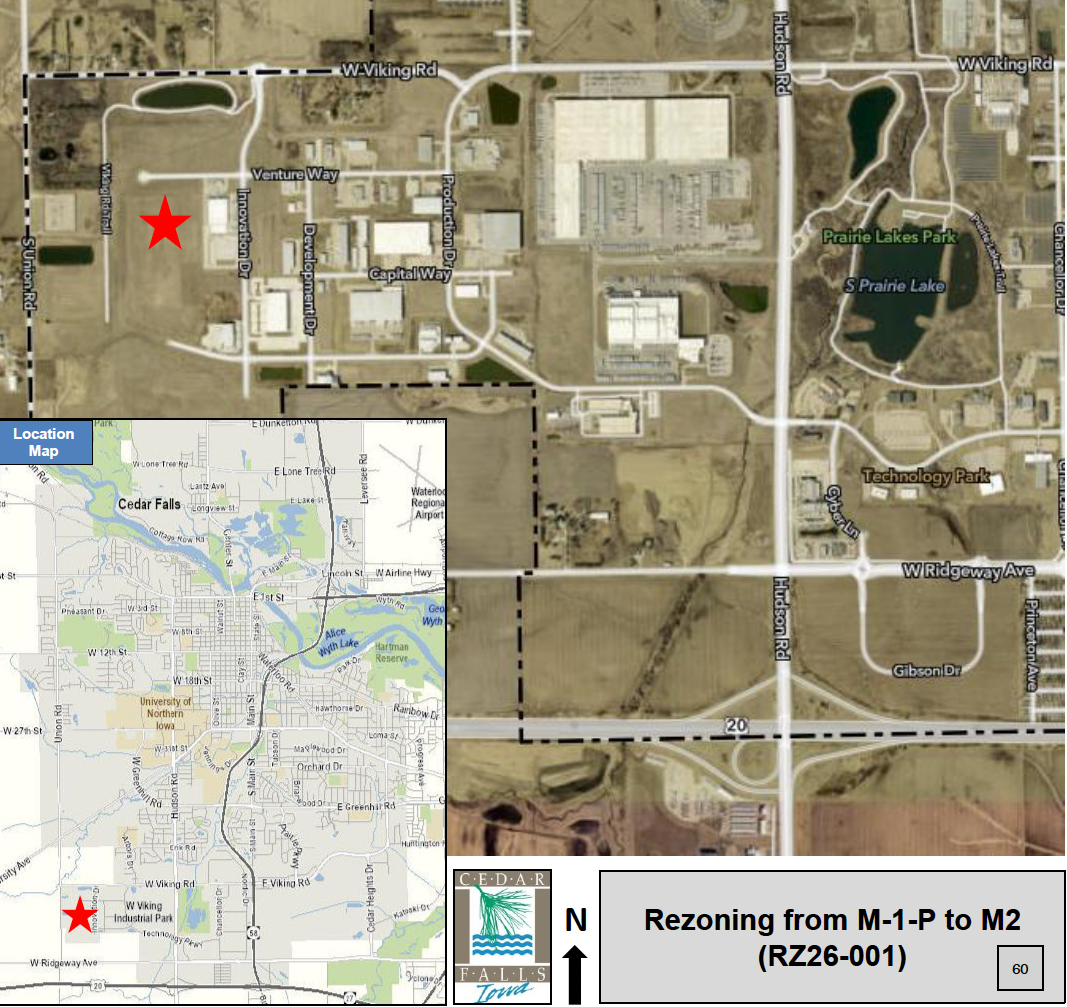
CFU plans to buy 38.25 acres of land at West Viking Road Industrial Park where they will locate a new power plant. The proposed recommendations call for this land, currently zoned M-1-P, or light industrial, to be zoned heavy industrial, or M-2.
During the meeting, Tom Risse, CFU’s project manager for the Viking Energy Center, in response to a question, clarified that the planning for a new plant, which he said started in 2022, is “separate” from the request for the expansion of the cryptocurrency mining operation.
“There was nothing associated with Bitcoin, mining, or crypto mining, this was simply a matter of trying to plan for the future, for our electric generating facilities. It’s as simple as that,” he said.
Risse said the utility had been working on a succession solution to address the future needs of the city for the next 50 years. As an example, Risse noted that the transformer they had ordered takes three years to build.
“Our customers rely on us, and so we provide essential services, and that’s what we’re trying to continue to provide,” he said. “So, for us, that’s the main reason behind what we’re doing, what we’re working on.”
Risse said the existing infrastructure is aging and replacing it all at once would be cost prohibitive.
“Having ownership of local generation is better than relying on somebody else for the generation,” he told the commission. “It’s more economical, it’s more reliable. Since we can’t replace all of our electric generation at one time, so by adding this facility there, this allows us a more responsible way, more economical way, to replace our existing infrastructure over the years. We think this is a good approach.”
He said CFU and the city had been discussing several options in order to locate the new electric production plant near CFU’s existing electrical infrastructure, which is the Viking substation, located directly west of the proposed utility plant.
The new plant, he said, will “bring long term reliability and affordability for our Cedar Falls Utilities customers.”
He said the proposed generators can come online and be shut down “very fast.”
“They’re very efficient. They help keep the electric bills low, because we do have control over the local generation” he said. “And if there ever was a great emergency, this facility would be key in a black start situation, or if there was a peak in the wintertime, peak in the summertime.”
In response to concerns from the audience about noise, Risse said that the plant will use reciprocating engines, which he described as “very fast starting, fast stopping,” reliable and compatible with “a lot of renewable energy in our area.”
He said the size of the lot would allow for mitigation measures, including setbacks, noise and aesthetics.
“It’s all closed loop water systems that we’re not digging any on site wells. We don’t have any water discharge,” he said. “And from the outside, you can’t even tell that it’s a power plant.”
Another utility representative, Bill Skubal, director of energy resources for CFU, explained how CFU works with Simple Mining.
He said that cryptocurrency mining operations pay 100% of their costs and added that such operations use power “when it’s dirt cheap in the middle of the night,” and they can be powered down quickly in case of overload.
“The big value they have is, with that curtailability, when power prices are sky high, they’re getting shut off,” Skubal said.
“So they’re living on cheap energy when it’s available and when it’s not, they’re shutting down. So as long as we have the capacity in our lines to feed them, it’s not really a burden on our system. And when it does become a burden, we shut them off.”
Skubal said cryptocurrency mining customers pay reduced rates because they use resources at night, and also because “the crypto miners are willing to shut off, and for extended periods of time, like up to a week.”
“We would give that same rate to any customer, residential or not, in town, if they’re willing to let us shut your power off for a week to save money,” he said. “So they have volunteered to do that and that gets them a reduced rate, because it reduces our cost, and we are not contractually obligated to buy that power. That is a market that we bid into every day.”
Simple Mining rep comments on company’s local roots, benefits to the city
Matt Hein, director of energy, infrastructure, and site development at Simple Mining, introduced the company and responded to some questions from the community. He also expressed his concerns about the proposed code.
In making his case, he said Simple Mining is a local company, incubated by a University of Northern Iowa grad, entrepreneur Adam Haynes.
“I want my future grandchildren to live and work near me,” Hein said. “I want Cedar Falls to be home. That’s why we build. We build infrastructure to support community growth, and we build in-house training for high tech jobs. It’s simple.”

He described Simple Mining as a “technology infrastructure and hosting company, and a repair company” headquartered in the Industrial Park.
“We are not outsiders,” he said. “We provide infrastructure for customers to run high performance computing hardware. Our growing team of repair technicians are skilled at diagnostics, micro soldering, and other high tech maintenance work. These are the exact kinds of skilled, well paying jobs that keep families in the community and keep our young people from moving away.”
Currently, 100 employees work at businesses owned by Haynes, Hein said. If the crypto mining operation is expanded, that would bring the number to 150 employees, he added.
He said that by working with CFU since 2021, Simple Mining has demonstrated its commitment to the community.
“The community gets grid reliability, the utility gets steady, manageable load, and we need to compete globally while staying local,” he said.
Among the benefits to the community, he said the company “may be one of the largest taxpayers” in the city.
“There are complex mechanisms that make that work, but effectively, our large consumption of electricity is an economic benefit to the City of Cedar Falls. We help pay for schools, we help pay for roads, by our operations,” he said.
He added that CFU and Simple Mining are environmentally minded.
“In fact, both of us are very much environmentalists that we would like to see more renewable energy on the Iowa utility system,” he said.
“So, we get a lot of pushback environmentally, but one of the reasons that we’re continuing to increase the amount of renewable energy in Iowa is because we do have flexible power plants.
“You can’t have a wind turbine that constantly spins. You can’t have a solar panel that constantly produces energy. So CFU’s job is to balance the system. We help them do that,” Hein said.
In response to questions about water use, he said the company uses “almost no water” in its mining operations.
“In terms of water use, I can say that our largest water use is our high efficiency flush toilets,” he said.
He noted the company’s collaborative approach to addressing emerging issues and said they want to “contribute to the community in terms of economic development.”
“We certainly pay our fair share in terms of electricity, and, again, a cost of service study would certainly show that that is the case,” he said.
At the end of the meeting, Hein also raised concerns about the proposed language of the zoning draft, saying that cryptocurrency is singled out in the document.
“If noise limits, setback requirements, power consumption thresholds, or operational conditions, are appropriate standards for protecting the community, then they should apply equally to every business in that zone. Not just one category,” Hein said.
Community and neighbor concerns
During public comments, three members of the Nebbe family, who have worked for over four decades to preserve the land and the wildlife on their 22-acre homestead, which is adjacent to the proposed land for rezoning, spoke to applause from the audience.
Charity Nebbe, her brother, Nathan, and their father, Dennis, told the story of a family who had dedicated their lives to preserving and healing the land and its wildlife and sharing their “environmental oasis” with community-minded generosity and purpose.
Charity Nebbe attested to the “devastating” impact the proposed rezoning would have on the land, its creatures and her aging parents.

Her mother, Linda Nebbe, worked as a school counselor and a UNI professor and founded two enduring environmental organizations, Black Hawk Wildlife Rehabilitation Project, and also Pet Pals. With her work, Linda Nebbe helped educate generations of kids about wildlife and nature.
Speaking in a measured tone and with powerful words, Charity Nebbe explained how, over the years, as the industrial park grew around her family’s property, and as their neighbors left, the Nebbes chose to stay and continue to live out their values and legacy.
“This is our family legacy,” she said. “This is something we really believe in, in healing this land and staying on it.”
She said if the projects are allowed the value of the family’s homestead would plummet.
“This is not only emotionally devastating, but also a situation that is financially devastating, as well.”
She said she understood the imperative of city growth and economic development, and that “Cedar Falls, Iowa, doesn’t make its decisions based on the needs of one family,” but she urged the commissioners and the city to think about their own legacies and the future of the city with their decision making.
“It is not a long-term investment with vision and legacy in mind,” Charity Nebbe said of the plans. “And I just ask you to think hard about living your values, and what Cedar Falls wants to be in the future. What is the legacy of this community?”
Dennis Nebbe, Charity’s father, asked to speak from his seat, as age weighed on him, but the chairman asked him to come to the lectern and use the microphone, as the process requires. He walked slowly to the mic, but his voice steadied when he spoke about the family’s care and love for the land and for the “multitudes” of fawns, coyotes, fox, bunnies and eagles and other creatures they had nurtured.
“Our place has been something that we have thought about for years and years,” he said. “When we’re gone, it’s gonna be a real asset, a real place of joy, of nature, for the people of Cedar Falls. And what we were hit with two days ago, just absolutely, was like getting banged over the head.”
Other audience members express concerns
Questions around the plans for the new power plant and the cryptocurrency mining operation persisted as audience members wanted to know, for instance, if the plan for the municipal rezoning is approved, what rules would be in place if CFU wants to lease part of their property to businesses.
Some speakers opposed cryptocurrency operations being built in town and pointed to the state of the industry, others worried about specific issues, like the impact on the environment, noise and water consumption.
A community member asked if an environmental impact study had been done and whether the plant could be operated under a light zone.
Commissioner Kristin Moser said she would like to see more environmental studies prior to making a decision, especially in terms of resource needs and water impact.
Alan Stalnaker, who presided over the meeting, asked to see more information about the differences between the allowed uses in the M-1-P and M-2 zoning. He also said that no specific request for expansion is being considered at the moment, but just the text of a zoning code regarding cryptocurrency operations.
Commission members also asked CFU officials about the difference between cryptocurrency mining and data centers. That topic was not on the agenda, and Karen Howard, planning and community services manager for Cedar Falls, pointed out that it was outside of the scope of the meeting’s discussion. She added that data centers are very different from cryptocurrency mining operations and it would take a separate conversation if data centers were to be considered.
One of the differences between a data center and a cryptocurrency mining operation is that the former needs continuous power supply and the latter is curtailable.
Noise was another concern expressed at the meeting and Commissioner Brent Johnson asked if the community and the commission could see plans for the plant in order to understand noise generation.
The most vocal concern about noise came from Brett Jaden, who owns Air King Filtration, located next to Simple Mining. He said noise had been an ongoing problem.
“I look forward to what they’re going to do to further mitigate it,” he said. “But as I sit in my office every day working, I have the ongoing droning noise. Constantly present, every day, eight hours a day, nine hours a day in my ear. Gets a little bit annoying.”
He asked the city to consider aesthetics rules that are commensurate with the two-story high containers the cryptocurrency operation handles.
“So I think it’s gonna maybe put a little bit of a damper on what the city and the planning and zoning has worked very hard on for years to have us not only have a great industrial park, but a good looking industrial park,” he said. “That means a lot to people.”