


By Brady Reeves
On June 20, The Hearst Center for the Arts scattered 16 musical experiences throughout Cedar Falls for Making Music Day. Drum circles, children’s activities, workshops and live performances unfolded at venues across the city, creating far more opportunities than one reporter could possibly attend.
I made it to two: a morning drum circle at Overman Park and an afternoon of sidewalk performances organized by the Cedar Valley Acoustic Guitar Association downtown.
At the drum circle, I found myself seated among the participants. On Main Street, I listened as local musicians shared the songs, harmonies and friendships they had built over many years.
Together, the two experiences showed me what can happen when music is placed directly into everyday community spaces and the lives they hold.
Renewal through rhythm
The drum circle began with 4 people seated beneath the morning sun at Overman Park. Before long, every chair was filled.

Young children unabashedly settled into the dewy grass as the circle expanded to approximately 15 smiling faces. Participants chose from an assortment of percussion instruments, including maracas, fruit-shaped shakers, bongos, djembes, guiros, tambourines and rainmakers. Some stayed for the entire session. Others joined for only a few minutes while making their way through the Cedar Falls Farmers Market.
There was no audition and no expectation that anyone would arrive knowing what to do. I snagged the bongos, took my place among the group and listened for the pulse.
Barbara Ashton, director of music therapy at Wartburg College, guided us through activities including call-and-response, breath work and a rhythm-based version of telephone. She introduced a simple beat, then invited us to add our own rhythms and build upon it together.
Ashton said experiences like this help people reconnect with what she calls their “inner music child.”
She has nearly 15 years of experience as a music therapist, with a focus on supporting adolescents and adults facing mental health challenges and histories of trauma.
“I love to use singing and drumming to help promote relaxation, stress management, expression of feelings and community building,” Ashton said.
Those benefits became evident from inside the circle.
At one point, Ashton invited us to match our breathing to the rhythm. Later, we added our voices, singing the words, “The ocean refuses no river,” as the drums continued beneath us.
The steady collective pulse gave each participant room to experiment without feeling exposed. Some played confidently. Others tapped lightly while watching the people beside them. Children explored whichever instrument caught their attention. Every contribution became part of the larger sound.
“In times like these, music and any kind of group music activities add to our collective resilience,” Ashton said.
At the center of the circle sat one of Ashton’s most meaningful instruments, a djembe crafted by artisans in Mali. Throughout the session, she invited participants to take turns playing it.
By sharing the drum, she offered others a chance to experience something precious to her. That openness carried through the circle as participants shared space, rhythm and attention with one another.
Ashton said music therapy can add another dimension to a person’s therapy regimen, particularly for those who need an outlet for energy, difficult emotions or experiences that may be hard to express.
“You can connect to yourself without having to use words,” she said.
Ashton leads a monthly music therapy group in Waverly focused on body liberation, which she described as working to undo systems including ableism, racism, diet culture and sexism that restrict people’s ability to exist as they are and participate fully in society. The group explores stress management, boundaries, self-expression and community building.
For organizers, that sense of community was central to the day’s larger purpose.

Cory Hurless, cultural programs supervisor for the City of Cedar Falls, said accessibility was part of what made the citywide event meaningful.
“To be able to bring what we do inside of a building and bring it out into the community and meet people where they are, it’s such a different experience than having events at the Hearst Center,” Hurless said.
Rather than asking residents to seek out the arts, the Hearst Center brought music to places woven into daily community life, from parks and downtown sidewalks to classrooms, shops, galleries and other gathering spaces, allowing the organization to reach people who may not have otherwise walked through its doors.
“Getting to meet people who may never come to your organization and getting the opportunity to talk to these people about music and art and get them excited about it, it’s a whole different perspective,” Hurless said.
Music has remained a personal source of connection throughout different periods of Hurless’ life.
“Music for me was a saving grace as a teenager,” Hurless said. “Now that I’m an adult, it can change everything about your mood, how you feel about your day and how you feel about other people.”

Hurless credited the Hearst Center staff, particularly Programs Coordinator Sheri Huber-Otting, with transforming Making Music Day from an idea into a citywide experience.
“I’m so proud and amazed by the staff,” Hurless said. “Although I’m the leader of this organization, it’s the people who work here who make it all happen, and I’m excited to support everything and anything they want to do.”
Huber-Otting summarized the goal simply.
“We are trying to share the love of music with the community,” she said.
Hometown voices, sidewalk serenades
Later that day, I followed the music downtown.
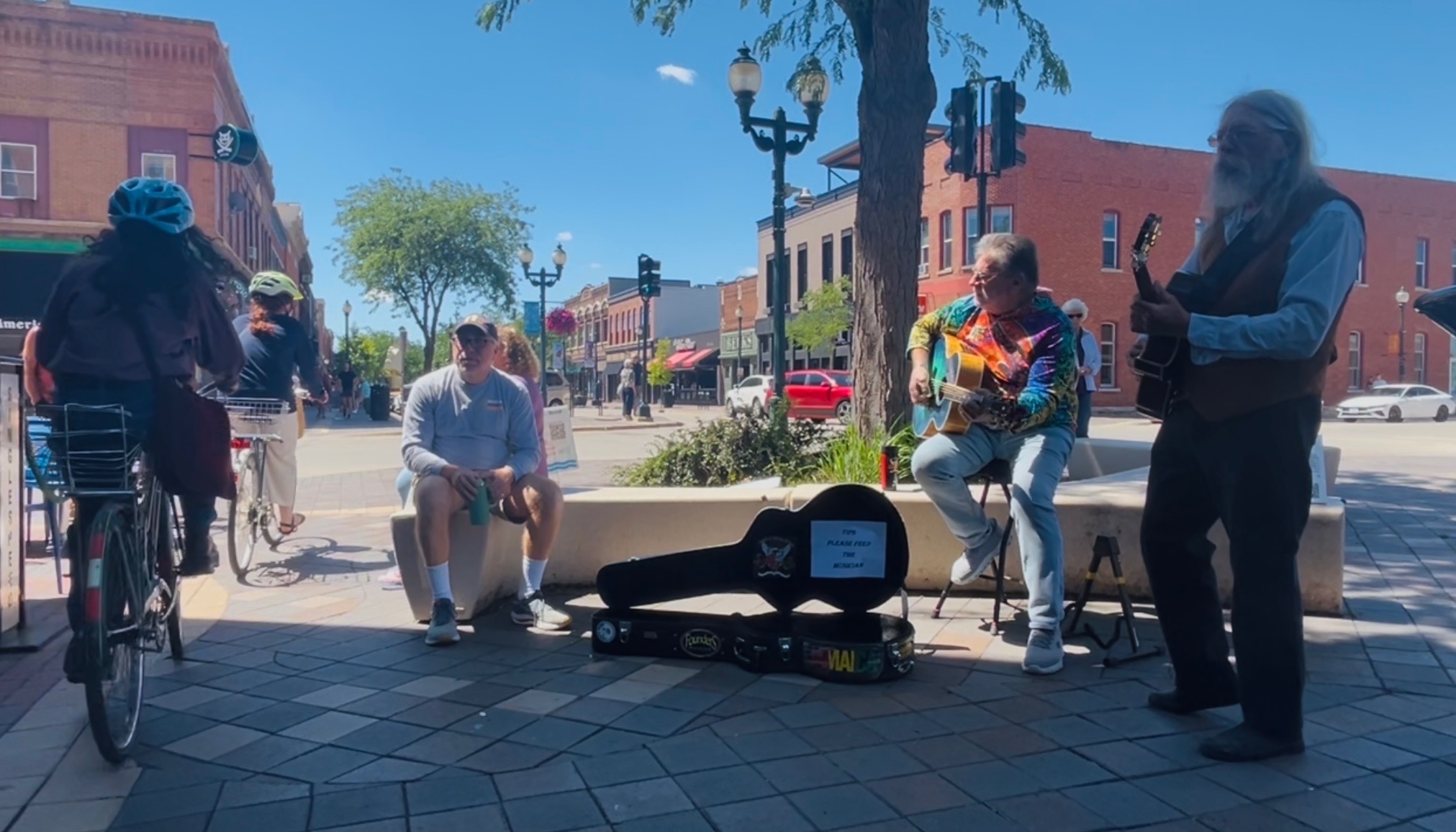
Members of the Cedar Valley Acoustic Guitar Association performed at several locations along Main Street, turning sidewalks and storefronts into temporary stages. The performances did not interrupt downtown life so much as become part of it. People stopped to listen, watched for a few songs and then continued with their afternoon.
The setting felt personal, with no barriers between the musicians and passersby. With the sounds of Main Street as a backdrop, I could hear each instrument clearly and connect with the performers once the music ended.
Rick Vanderwall, a co-founder of the Cedar Valley Acoustic Guitar Association, helped establish the group in 1998. A former University of Northern Iowa professor who taught future English teachers for 40 years, Vanderwall understands the importance of creating spaces where people can learn alongside one another.
The association meets on the first Thursday of each month and gives guitarists an opportunity to move beyond the isolation that can come with practicing alone.
The association gives musicians a place to share songs, refine their skills and connect with people who understand the rigorous and vulnerable process of becoming a stronger performer.
“It has created a community,” Vanderwall said.

As someone who also plays guitar and sings, I understood the value of what he described. Practicing alone can feel safe, but it cannot recreate the experience of playing in front of someone, making a mistake and continuing without missing a beat.
The musicians downtown demonstrated that resilience repeatedly. A missed note did not derail a song. A passing truck, nearby conversation or sudden distraction simply added another detail to the live soundscape unfolding along Main Street.

Vanderwall said the Cedar Valley has long supported musicians willing to share their work.
“Cedar Falls and Waterloo have always been great live music towns,” he said. “It’s an ever-changing dynamic.”
Among the musicians I heard were Vanderwall, Karla Ruth and Deb Niermann, along with Uncle Chuck Finch and Barry Miller.

Ruth and Niermann immediately stood out to me because of the way their voices fit together. Their harmonies sounded so natural and complimentary that I wanted to know how they had developed them.
Ruth told me the answer was persistence.
She had known Niermann for years, but it took time to convince her to step forward and sing. Niermann would contribute quietly from the background, prompting listeners to ask why she did not join in.
The turning point came during a Christmas open mic when Ruth was preparing to sing “Santa Baby.” She asked Niermann, who already knew the song, to sing alongside her.
That performance marked the beginning of their musical partnership.
Their sound later gained another dimension when Ruth surprised Niermann with a mandolin for Christmas. Niermann now plays it during their live sets, adding a bright, lilting texture alongside Ruth’s guitar and lead vocals.

Ruth has played guitar since she was 9 years old and said she always wanted to become a singer-songwriter, even while working what her father called “real jobs.”
After graduating from UNI in 1982 with a music minor, she worked in television and radio. At KWWL, she became the first woman to direct “The Hayden Fry Show” or any of the station’s coaches’ shows. Her work also included sports features, photography, producing, studio production and production management.
In 2000, Ruth took what she described as a leap of faith and left her job to focus on writing and recording her first album. She has since produced three albums of original material and performed throughout Iowa and in Chicago.
As someone who also plays and writes music, I understood the tension she described. I asked what advice she would offer musicians struggling to make room for creativity alongside life’s other responsibilities.
“If you’re a musician, you’re always a musician,” Ruth said. “You may be busy doing other stuff for a while, but you’ve got to do what you love.”
Work and other responsibilities may temporarily demand more attention, she said, but they do not erase the part of a person that needs to create.
“If you really love music, don’t put it in the background,” Ruth said. “You’ve got to do it. Follow your heart.”
Before I left, Ruth and Vanderwall encouraged me to attend one of the association’s future gatherings and bring my guitar.
The invitation captured what I had witnessed throughout the day. Making Music Day was not simply about performing for the community. It showed residents that music was not reserved for polished performers. There was a place to begin, room to grow and a local community ready to encourage that growth.
The invitation also brought the day full circle, echoing something Ashton had said during the morning drum circle.
“Everybody can be musical,” Ashton said. “Everybody can play something and express themselves through music.”