

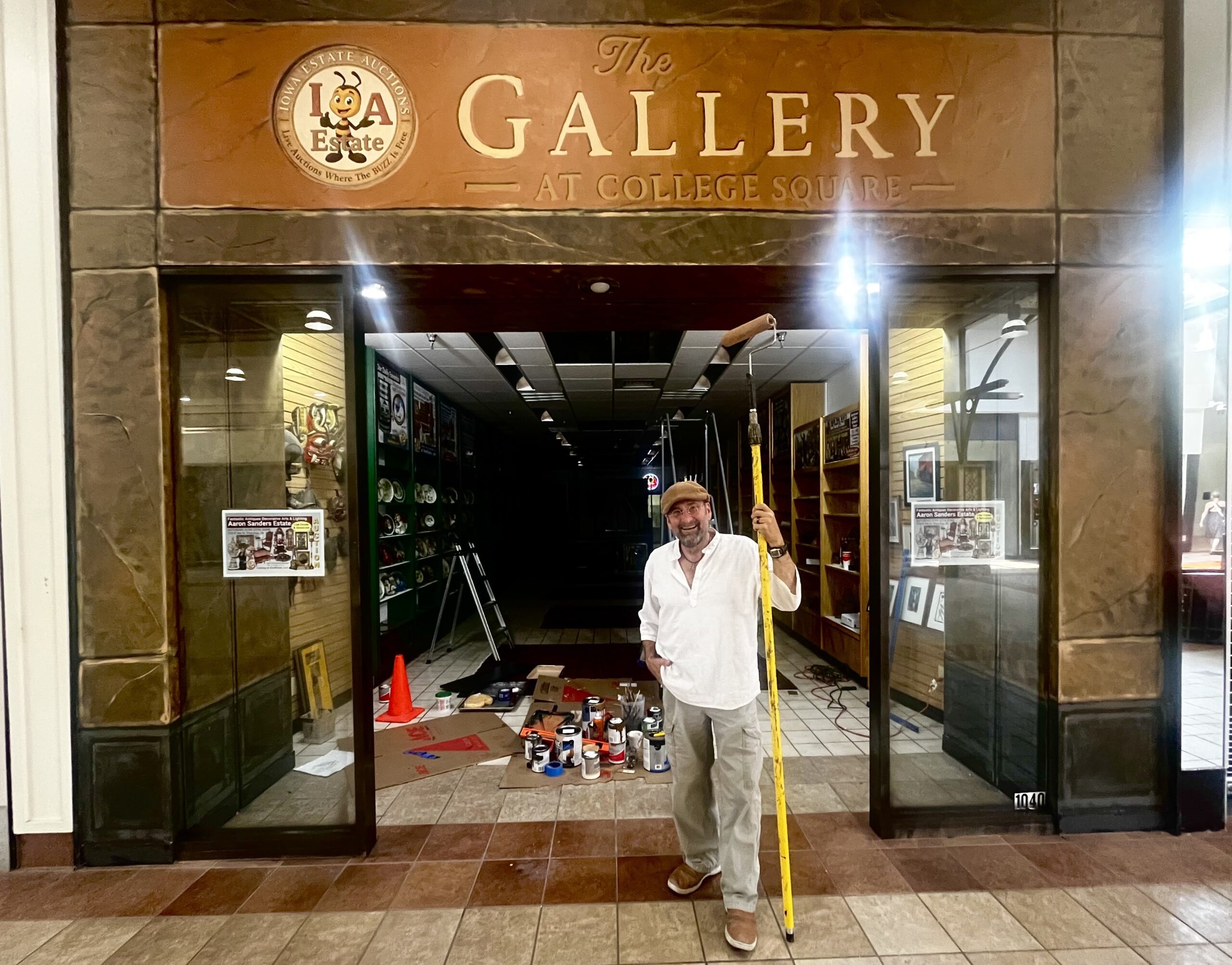

Transforming the ordinary into the extraordinary is the calling card of Cedar Falls artist Bryan Sink.
His latest projects include a freshly unveiled storefront for The Gallery by Iowa Estate Auctions at The Mall at College Square in Cedar Falls and a 30-foot mural in Waterloo paying tribute to generations of military service as the country marks its 250th anniversary. Together, they illustrate the range of his talent and the fervor with which he keeps creating.
From storefronts and murals to painted portraits, Sink brings character, atmosphere and heart to every project he takes on.
A mural shaped by service

Sink expected the sky to be brighter.
As he painted his latest mural across eight panels laid on the floor of a Waterloo warehouse, he initially imagined a clear and colorful backdrop for its scenes of American military service.
Instead, smoke, fire and shadow began to take over.
“It immediately started taking on a dark tone,” Sink said. “It was not a bright, cheery, primary-color mural. It was kind of a smoky, fiery, explosive, fog-of-war mural.”

“I was going to have a pretty sky,” he added, “and I didn’t get one.”
The finished mural measures approximately 30 feet long and 7 feet tall and now hangs high on a warehouse in the 200 block of Sycamore Street in Waterloo. Its imagery moves through generations of American military service, from the nation’s earliest conflicts to modern drone warfare.
One section includes a tank modeled after the one Sink served on as a member of the Army’s 2nd Battalion, 63rd Armor Regiment. Another depicts the flag raising at Iwo Jima, while a present-day Black female soldier operates a drone.
Sink wanted the people depicted in the mural to reflect both the diversity of those who have served and the Waterloo community where the work now lives.
“It’s Waterloo,” Sink said. “It has to be that way, and it should be that way.”
The mural began with a trade.
This spring, while preparing his Cedar Falls home for his daughter’s graduation party, Sink wanted old-fashioned bricks to create paths through his yard. Rich Penn, whose father-in-law, World War II veteran Kenneth Martin Armfield, would later be depicted in the mural, had a large stack available. Sink offered to exchange his work for the bricks.
They did not initially decide what that work would be.
After Sink completed the paths, Penn approached him about painting a mural on a Waterloo warehouse he owns. As the United States marked its 250th anniversary, Penn and his wife, Sharon, chose military service as its subject.
The project carried personal connections for both families.
Sink served in the Army, and his great-uncle, Maj. Gen. Robert F. Sink, commanded the 506th Parachute Infantry Regiment during the Normandy invasion.
Sharon Penn’s father, Private First Class Kenneth Martin Armfield, served in Europe during World War II.
In a Facebook post about the mural, Rich Penn wrote that family members had recently researched Armfield’s military records. According to Penn’s account, Armfield served as an automatic rifleman in Company K of the 134th Infantry Regiment and received a Purple Heart and six bronze stars.
Penn wrote that his father-in-law rarely discussed his wartime experiences after returning home to Iowa. However, Armfield’s daughters remembered the scars on his legs and the night terrors that followed him home.
As Sink and Penn compared their family histories, they realized Robert Sink and Kenneth Martin Armfield may have fought through some of the same areas during the war without ever knowing one another.
Penn wrote that Robert Sink’s paratroopers landed behind enemy lines ahead of infantry units that later advanced through the region, similar to Armfield’s regiment.
Sink described the connection as serendipitous.
The men “probably never knew each other,” he said, but may have been “in the same place at the same time.”
The artist behind the mural
Sink was born and raised in Cedar Falls. His grandparents were also Cedar Falls natives and operated Garrison Gardens, a large roadside produce stand once located near the former Black Hawk Rollerdrome.
At a young age, Sink often felt out of place in school and knew a traditional path was not for him. Although he understood that creativity would be important in his life, he had not yet found an outlet for it. He dropped out of high school and, at 15, began cleaning windows on skyscrapers in Dallas and Houston. At 17, he joined the Army.
His career later took him through hotel music circuits, upscale hospitality and restaurant ownership across Texas and Arkansas.
Sink returned to Cedar Falls with his wife, Corrie, in 2013 after his mother became ill. They bought their Cedar Falls home, where his mother spent her remaining years with them.

At his home, deep reds, amber yellows and weathered materials surround paintings, instruments and objects collected over the years. Murals cover surfaces inside and outside the house, while gathering places have formed around a porch swing, fireplace and outdoor cook stove.
Sink has continually painted, decorated and reshaped the property since returning to the Cedar Valley.
The mural’s smoke, fire and shadow reflect a visual language that also shapes Sink’s Cedar Falls home, the restaurants he created and the many other Cedar Valley spaces he has helped bring to life: rich color, weathered textures and environments layered with personality.
Sink prefers warm light to the glare of fluorescent bulbs. He gravitates toward reds, yellows, patinas and raw materials rather than clean white surfaces.

“I hate white,” Sink said. “I just hate white.”
He believes that preference was shaped partly by his years in the restaurant industry, where familiar reds and yellows became part of his visual vocabulary.
“The ketchup and mustards,” he joked.
Although Sink knew as a child that he wanted to live creatively, visual art did not enter his life until decades later.
“I knew I was going to live an artistic life because everything that I saw in the world, I thought about how it could be and how I could reshape that,” Sink said.
He was not necessarily thinking about painting. He was drawn more broadly to what he called “the art of creation.”
“Never looking at things for what they are,” he said, “instead looking for what their potential was.”
Sink did not pick up an artist’s tool until he was about 40. He and Corrie had sold a restaurant in Hot Springs, Arkansas, and he was between projects when she visited a local art store and brought home a box of pastels for him.
He immediately began teaching himself how to use them.
Hot Springs had an active arts community, and Sink found himself surrounded by experienced artists. A nationally known pastel artist and educator lived next door, giving him what he described as a brisk education in art.
He later opened another restaurant and bar that included a cigar lounge. He began using the pastels to draw images inspired by cigar labels and sold the pieces to tourists.
“I knew they weren’t that good,” Sink said. “But they were interesting, and people bought them.”
Painting pet portraits later showed him that art could become more than an experiment. His creative skills were largely self-taught and discovered later in life.
For Sink, however, painting, cooking and making music are all expressions of the same spirit to create.
Sink now works primarily with acrylic paint and rarely titles his pieces. He said he creates quickly, and estimates he has produced thousands of works. He does not usually become attached to them, as many leave his possession almost immediately.
His work includes traditional portraits, pet portraits, murals, commercial interiors and carved plywood pieces. By cutting and chiseling into the alternating layers of plywood he exposes patterns and textures that become part of the finished image.

Sink regards some of his portraits as among his best work. He described his painting of Cedar Falls native Rush Cleveland, who was inducted into the Iowa Blues Hall of Fame in 2023 as “kind of the epitome of my portrait work” and an example of the portraiture he most enjoys creating.

His dream is to receive a commission for a large series of portraits honoring the leaders or historical figures of an organization or community.
Rather than standard photographs of board members or former presidents lining the walls of a bank, hospital or other institution, he imagines carefully painted portraits that carry more personality and presence.
“I’d like to get back to the day when there’s an actual portrait of the presidents in the bank, or the historical figures in Cedar Falls,” Sink said.
His ideal commission would include 30 portraits.
“Let it take the rest of my life to do,” he said.
Whether he is painting a portrait or transforming an entire room, Sink is interested in more than how something looks. He considers what it could become and how it might make people feel.
The art of atmosphere
For Sink, painting a wall and designing a gathering place are closely related.
His approach to those spaces grew from decades in music, restaurants and hospitality.
After leaving the Army, Sink briefly attended the University of Northern Iowa before deciding he was unprepared for college. Music soon offered him another path.

From 1979 to 1986, Sink traveled the hotel circuit with Monogram, a folk-leaning, singer-songwriter group that toured the western United States, Canada and Mexico. The original trio took to the road in an El Camino, typically performing five nights a week and living at each hotel before moving to the next stop. Their success eventually led them to add a drummer and expand into a four-member band.

Living in hotels gave Sink access to the spaces behind their public-facing environments. He became familiar with the bartenders and cooks and found himself drawn to the appearance and energy of commercial kitchens.
A hotel manager eventually offered him work as a bar manager, but Sink quickly realized that he was more interested in the kitchen.
In 1986, at about 30, he applied for a job as a dishwasher at a high-end Four Seasons hotel in Dallas.
Sink noticed that the experienced cooks and chefs owned their own knives. With each paycheck, he bought another knife and added it to his growing set, showing the collection to the kitchen staff as proof that he was serious about becoming a cook.
“I want to be a cook, and I’m getting my tools together,” Sink remembered telling them.
After about two months, the executive chef approached him at the dish station and asked to see the knives. He then told Sink to remove his apron, report to personnel and tell them he was a cook.
Sink entered a formal culinary apprenticeship through Four Seasons Hotels. From 1986 to 1996, he worked for Four Seasons and other upscale hotels, eventually serving as an executive chef and food and beverage director in Dallas and Houston.
In 1997, Sink moved to Hot Springs, Arkansas, where he owned and operated Three Monkeys, serving as its chef as well. The restaurant featured a wood-fired oven and stove and held one of the first brewing licenses issued in Arkansas. It became both a tourist destination and a popular local gathering place, and Sink considers it the most successful restaurant of his career. He remained in Hot Springs until returning to Cedar Falls in 2013.

Upon returning to the Cedar Valley, Sink owned and operated Bryan’s on 4th and the Limestone Lounge in downtown Waterloo from 2016 to 2018. In 2017, Bryan’s on 4th was named Best Restaurant at the Cedar Valley Tourism Awards, recognized for its nightly entertainment, atmosphere and food and beverage offerings.
During that time Sink brought together food, artwork and live music. Musicians found a stage, while patrons found a place that felt distinct from the restaurants around it.
He later operated Bryan’s Blue Plate and brought that same creative instinct to other Cedar Valley businesses, contributing murals, entertainment, decorations and interior design.
Sink credits those restaurants with helping him rebuild a sense of community after returning to Cedar Falls. He had moved home knowing only a small number of people from his earlier life in the area.
Through the restaurants, he built a large circle of friends and community connections that he still values today.
“That will last my lifetime,” Sink said.

Sink has painted inside restaurants including Starbeck’s Smokehouse and King Buck’s. He also painted murals at Bob’s Guitars and transformed the swimming pool room of a hotel in Pella, covering its walls and ceiling with images of local landmarks.
The goal, Sink said, is not simply to decorate a room. It is to create an atmosphere that people can feel as soon as they enter.
“When I do any of those kinds of things, I’m just trying to create a vibe,” Sink said. “A feeling inside the environment that you can move through and be real comfortable in.”
He considers lighting, color and entertainment just as essential to a restaurant’s identity as its service, food and drinks.
“If you don’t have a cool light scheme that works, then a lot of your energy is wasted,” Sink said. “You never get that feeling in the place.”
At Bryan’s on 4th, Sink regularly placed musicians at the center of the restaurant’s identity. Live performances gave local artists a stage while offering patrons a reason to remain after their meals.
Food, artwork and music were not separate features of the business. Together, they created the experience Sink wanted people to have when they entered.
Between the studio and the stage

Sink’s relationship with the community extends beyond visual art.
His relationship with music began while he was serving in the Army and stationed at Fort Riley, Kansas.
During a trip through Iowa, Sink stopped to visit relatives in Council Bluffs and noticed a Yamaha guitar sitting in their living room. He told his aunt and uncle that he had always wanted to learn to play, and they offered to sell it to him for a small amount.
Sink took the guitar back to Fort Riley and began teaching himself.
“When I got the guitar, I wanted to learn to play like James Taylor,” Sink said. “That was it.”
He never took formal lessons but began earning a steady second income from music in his early 20s.
In 1976, shortly after serving in the Army, Sink performed at the first Sturgis Falls Celebration as one of a small group of entertainers, he said. Decades later, music remains part of his daily life.
His attention often moves back and forth between painting and performing.
“I go in spurts,” Sink said. “I’ll get real busy doing music. Then the mural broke that, and now I’ve got another mural to do right away behind that.”
These days, Sink performs covers at venues throughout the Cedar Valley and original music with his band, Three Eye Atlas.
Painting often requires Sink to work alone, whether he is creating a portrait in his basement studio or spending hours completing a mural. The finished work, however, becomes part of the restaurants, businesses and public spaces where people gather.
Even the Waterloo mural began with something ordinary: a stack of bricks exchanged between two people. From there, it grew into a reflection on military service, family history and the generations represented above the warehouse doors.
Music offers Sink another way to connect with the community around him.
“A lot of what I do is very solitary,” he said. “But through the music and stuff, I get out every day. I’m always in the mix.”