

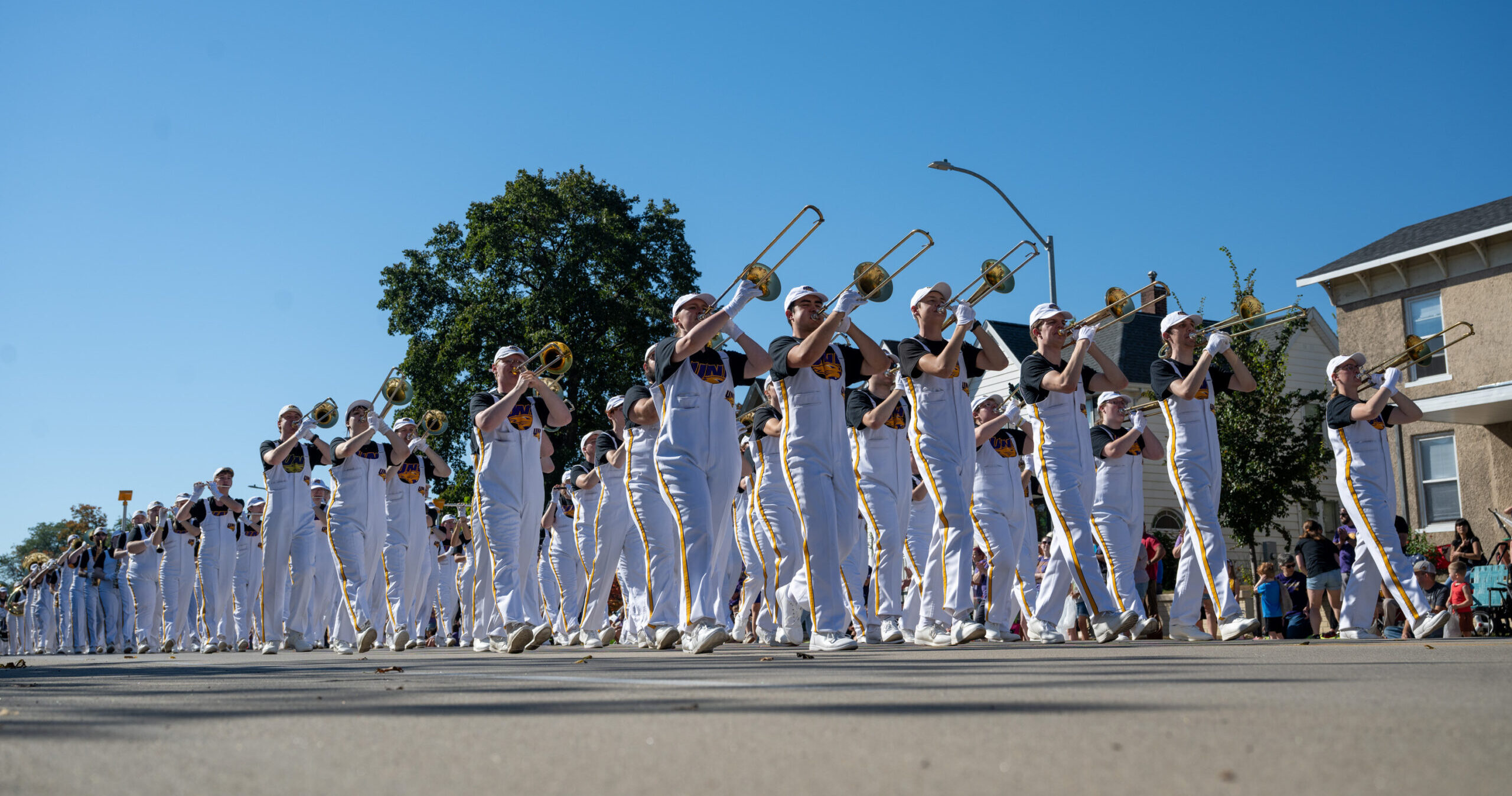

Enjoy browsing through the picture gallery of the 2026 Homecoming parade
By Anelia K. Dimitrova
Purple and gold fueled spirits and filled up nine blocks of Main Street on Saturday morning to mark the 150th anniversary of the University of Northern Iowa with a Homecoming parade, one of the culminating events wrapping up the university’s year-long celebration.
One hundred fifty years of history is a notable milestone for the institution that planted its roots in the community in 1866, first as a home for children orphaned during the Civil War, and a decade later, in 1876, opened its doors as a teacher-training school.
The legacy of the school’s beginning and its transformation into what UNI is today shined powerfully in the parade floats and in the community of supporters, who had packed the sidewalks to cheer on the accomplishments of the college.
This fall’s Homecoming theme, “The Future is Purple,” was on full display on this blue-sky October morning, with the gentle sun keeping the temperature around 70 degrees. There was so much to celebrate and so much to appreciate, as today’s students, faculty, family members, alumni and the Cedar Falls community keep holding up their end of the purple pledge.

The parade was an engaging way to tell the story of the past century and a half in the present moment and claim a purple future. The homecoming tradition dates back to 1920 as reported by the College Eye, the student newspaper at the time. The first Homecoming parade took place in 1922, according to UNI Homecoming History, a publication of Special Collections and University Archives. Over time, homecoming celebrations have reflected the institutional evolution of the university, but in essence, the themes have mostly echoed the goal of connecting students, alumni and the community at large. For the sesquicentennial celebration, making that connection across generations and reinforcing the importance of legacy in building the future, was central to the 2026 parade.
Most fittingly, in the float lineup, three great great grandchildren of James Cleland Gilchrist, the first leader of the institution who served from 1876 to 1886, made that very connection. Elliott Gilchrist Smith and his sisters, Cam Axelrood and Stephanie Smith, marked that point in time. In the parade, sitting in the back of a truck, they held up cutouts of Gilchrist’s portrait, drawing the arc of history from the time of Gilchrist’s stint to Oct. 10, 2026, the day of the parade.

At the other end of the arc of history was Mark Nook, the president who has helmed UNI in the last decade. He sat atop a white Corvette Stingray and waved at the onlookers amidst cheers. From time to time, he took off his hat in appreciation of the applause and responded with, “Happy homecoming!”

In the dignitaries’ lineup, family members of the late Gary Kelley, a beloved illustrator of international renown, held his portrait and waved to the appreciative crowd. Kelley graduated from UNI in 1968.

Another UNI grad, Cedar Falls Mayor Danny Laudick, emphasized, with his presence, the relationship between the city and the campus community, but also, underscored the fact that a lot of UNI grads return to the area to benefit the community that had nurtured them. He and his wife, Jesse, rode in the back of a truck. While the mayor waved at the parade-goers, Jesse cradled their new family member, a Great Dane puppy called Bronx.

By far the largest, loudest and most energetic participant in the parade was the storied Panther Marching Band. Its music brought many of the spectators to their feet. As they marched on, many of the onlookers noticed the band’s four-legged member Winnie, the golden retriever service dog helping percussion member Gabi Riessen. A PBS crew working on a story about Winnie and Gabi followed the band as it headed downtown.


UNI’s mascots, TC, The Cat, and his younger sister, TK, The Kitten, rode on the float created by the Construction Management department, which featured a model of a rocket, and also noted, on a banner, that UNI was named #1 public regional university in the Midwest by U.S. News and World Report.


Another notable float was that of the UNI Campanile, the most recognizable landmark on campus. Dedicated on Sept. 19, 1926, the campanile marked its 100th anniversary this fall.

Among the staples in other homecoming parades were also the floats of international students, the Varsity Men’s Glee Club, the Northern Iowan, the college newspaper, which published its first issue on Jan. 12, 1892 ( this writer is the co-adviser for the publication). Also in the parade were groups like the UNI Dance Marathon, sports teams and other student organizations.


In picking out the floats that most creatively represented the spirit of the celebration, the judges were hard pressed to select the winning floats, as there were so many to consider.
The float for the UNI Spectrum Project, which is an inclusive art-focused program for area kids and young adults, won an award for the best theme; in the department category, Business Community Services was picked; in the community category Cedar Valley Roller Derby, the Waterloo-based group, took the top spot; the judges’ choice award went to the Brazilian Samba Ensemble led by music professor Staci Toma; the president’s award was earned by the international students’ float; and the grand marshals’ award was given to UNIdos, a student organization.
“Homecoming is always a special time for the Panther community, but this year’s celebration carries even greater meaning as we conclude UNI’s sesquicentennial,” UNI President Mark Nook said in a press release announcing the 2026 Homecoming theme. “It is a privilege to celebrate 150 years of Panther pride, traditions and impact alongside our students, alumni, faculty, staff and friends. The energy and connection that Homecoming brings to campus truly the spirit of UNI.”

Enjoy browsing through the picture gallery of the 2026 Homecoming parade