


By Kolton Becker
For 30 years, David Bingham has witnessed through the lens of his camera the crowning of champions and the crushing of dreams at the UNI-Dome in Cedar Falls during the State Playoffs of the Iowa High School Athletic Association (IHSAA).
This season, as the state’s signature high school football competition marks its 50th year at the Dome, Bingham, the co-owner of Bing Bang, an Urbandale-based media company, says the milestone doesn’t just mark an important anniversary.
Rather, it captures the sustaining passion that fuels the sport as well as the dedication of generations of teams, coaches, organizers, families and fans who continue to contribute to the tradition.
“I appreciate anybody who loves high school football,” said Bingham, a 1991 UNI grad. “I think it’s extremely important to our roots and what’s going on in Iowa.”
In half a century of achievements, the Dome has become a destination for IHSAA — the place where wills are tested, memories are made, and team sports legacies are sealed.
In that time under the Dome, nearly 800 games were played, 1,000 teams tested their mettle and three million spectators from around the state have proudly cheered on their communities’ athletes here.
In that time also, as the host city, Cedar Falls has wowed the teams and their supporters with its hospitality from its unique downtown district to a recently re-energized College Hill.
“We are proud to be a part of this incredible tradition,” Cedar Falls Mayor Danny Laudick said in a video welcoming this year’s event.
2025 champions
In this year’s state playoffs, which took place from Nov. 12 to Nov. 21, some champions returned to glory and new champions were made.

In the 8-player championship, Bishop Garrigan defeated Woodbine in a thriller to start off the title games. A last-second touchdown and two-point conversion led to a 44-42 win, the school’s second state championship in the past three years.
In the Class A championship game, the MMCRU Royals took home the first state trophy in the program’s history in a 30-17 victory over Saint Ansgar. In the 2010s Marcus-Meriden-Cleghorn did win two 8-player titles, but then their mascot was the Eagles, before they started grade-sharing with Remsen Union.
In the Class 1A championships, West Lyon won in dramatic fashion as they defeated Regina Catholic 34-27 in overtime. This is the school’s second consecutive championship victory, as they were the Class 2A winners just a year ago.


Kuemper Catholic won decisively against Van Meter in Class 2A, 28-7. The Knights are able to take down a perennial football powerhouse to secure their first title since 2013.
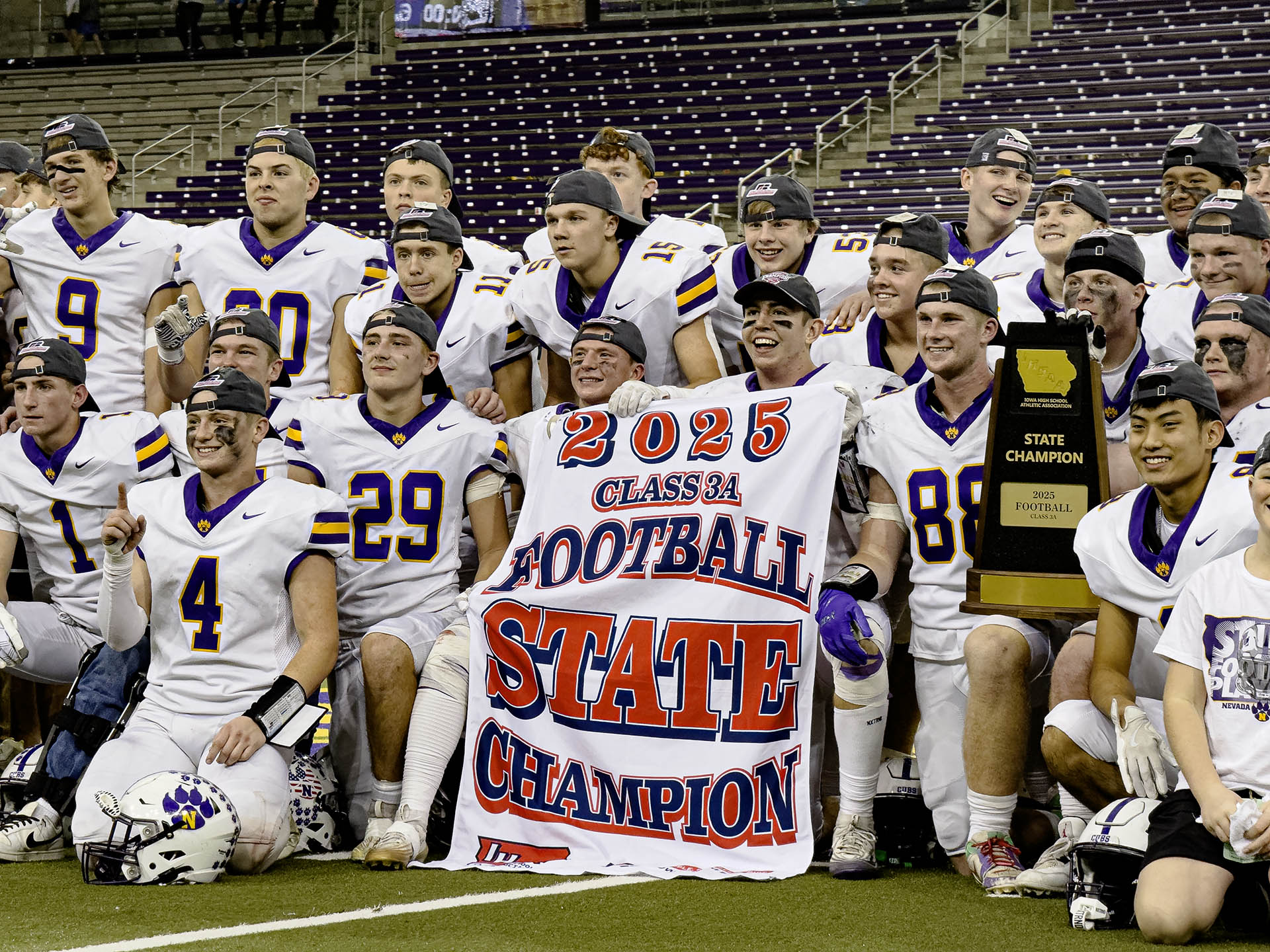
Nevada won the Class 3A championship 27-6 over Bishop Heelan to cap off one of the greatest playoff runs in recent memory. The Cubs took down two other highly-ranked opponents –Clear Lake and Solon — to get to this point.

Cedar Rapids Xavier took home the 4A title with a huge 31-6 win over Pella. This is Xavier’s third championship game appearance in the past five years and their fifth championship.
In the Class 5A championship, Dowling Catholic imposed their will on the ground, which led to a 27-10 win over Iowa City Liberty. The Maroons won their first 5A title along with their 11th championship total.
The Dome’s beginnings
Construction of the UNI-Dome began in 1974 and the facility would officially open in 1976. Right away, the IHSAA, which was founded in 1904, moved the championship games to the indoor venue. However, it wouldn’t be until 1998 until the semifinal games would be played at the Dome as well.
Since the inception of the Dome tradition, a lot of things have changed in all aspects of the event — from logistics to technology to the amenities to significant upgrades of the facility to the look and feel of the town.

But what has remained constant is the drive of young athletes to excel in the game since the first champions at the Dome — BCL (1A), Central Lyon (2A), Columbus Catholic (3A), and Davenport Central (4A) — claimed their titles in 1976.
Recalling the earlier years at the Dome is a trip down memory lane for old timers, like Jeff Trost, a former referee for over 30 years.
At the start, for instance, there were only four playoff classes at the time, and today there are seven.
Early on, other playoff games took place in the Dome, Trost said.
“In the early-round games, they had regional teams and brought them here,” Trost said. “It’d be area schools that were in the playoffs and they’d bring those teams in and play early rounds there.”
Ticketing was basic then, according to Shirley Wolf, a longtime usher and ticket taker at the UNI-Dome.
The old playoff tickets were a “little stubbed ticket,” she said.
These tickets were often designated for either reserved or general seating sections, unlike today’s general admission tickets.
Advances in technology have made the process of attending the state playoffs simpler, Wolf said.
“It’s more streamlined now with all the internet stuff,” she said. “We don’t have to have them physically have a ticket. They can have it on their phone.”
Over the years, renovations to the Dome have upgraded the experience for players and spectators.
Changes to the Dome’s iconic roof structure, a video board and AstroTurf have improved the atmosphere and safety of the facility. Recently, a new plan has been put into action to rework seating, add suites, upgrade the sound system, and make the interior space more navigable. The latest upgrades are expected to be completed by 2029.
Football in the hearts of Iowans
The Dome and the state football playoffs have evolved over time, but the significance of the event as a destination for the molding of young athletes still remains the same at its core.
“There’s been obviously an upgrade in branding and things like that, but for me, personally, the games, the coaches, everything is exactly the same,” Bingham said. “That’s what I love about it. It’s consistency, and I think that there’s so much going on with the character and the development, it’s kind of the bedrock.”
On the field, while teams fight for the trophy, in the stands parents, siblings, grandparents and others cheer on their home team. That energy the communities bring to the dome is always the highlight of every football season.

Former Belle Plaine football player Chris Cibula, who watched his son’s team, the Valley Tigers play on Nov.14, said he and his friends watched the games in the Dome when he was in high school. Now as a parent, he still loves the atmosphere as much as then.
“It’s just quite the great experience,” Cibula said. “Nothing beats being in here with the fans. It’s just super loud and it’s impressive. It’s pretty exciting. The kids just love this, this is what it’s all about.”
IHSAA Executive Director Tom Keating echoed this sentiment and praised the facility and the local community.
“It’s an intimate space for a football game,” Keating said about the Dome.
Packed more closely in a smaller venue than a Kinnick or Jack Trice stadium, the fans are energized by their proximity. The cheers sound louder, the gasps are more audible and the overall vibe of the space is more exciting, many agree.
“It feels like the fans and the players are enjoying the same experience,” Keating added.
He believes that the support from the local community is a big reason the event has grown to its current format.
“We can’t do it without a team,” Keating said. “It takes a village to do a lot of things. But you know, it might take more than a village, it might take a nation to do something like this.”
The organizers of the event, their partners and their Cedar Falls hosts are a part of the “nation” that makes the experience unforgettable and ensures the success of the event.

Chris Cuellar, IHSAA communications director, said as much in a LinkedIn post summing up the behind-the-scenes effort. In just two weeks, his department managed the streams and broadcasts of 21 games, those stretching over 50 hours total and garnering millions of views. To enhance the experience, they also produced in-house shows, graphics and free t-shirts, among others.
“There are countless people who got us here,” Cuellar wrote. “Thank you, thank you to talent (wow!), crew (Cedar Falls Channel 15 for 14 semifinals, then Iowa PBS for 7 finals), our staff, board, outstanding former interns, video goat, fans, schools, corporate and host partners, and every pro that offered an ear or a hand over the last couple years.”

The City of Cedar Falls is also an integral part of the collaborative effort to keep the event fresh and grounded in tradition all at once.
Jennifer Pickar, Tourism & Cultural Programs Manager for the city, said the state playoffs continue to contribute to the economy of the town.
“This event brings a conservative estimate of $2 to $3 million into the local economy each year,” Pickar said. “It draws between 50,000-55,000 fans to the UNI-Dome that go out before and after the games to support local restaurants, retailers, and hotels.”
While the city and the local merchants welcome the playoffs wholeheartedly, it is the Dome that is the destination for athletes and fans alike. And while only a few win, the experience at the Dome is a dream for many.
“I think that’s the draw,” said Bingham, the media agency co-owner. “It’s the consistency of being in the same environment. It’s good for the kids and I think it signifies a goal for them. The Dome is a goal.”