


By Brooklyn Draisey, Iowa Capital Dispatch
Paul Lasley’s hobby of restoring old and broken violins and donating them to Iowa State University’s instrument collection program didn’t start with a violin of his own, or really any other stringed instrument — it started with a tin clarinet.
When the retired ISU sociology professor was growing up in Queen City, Mo., he wanted to join his elementary school band. Lasley said his family couldn’t afford a new, black-painted wood clarinet, so he had to borrow an older, metal instrument from the school.
Now he’s working to make sure students who hope to find belonging and opportunity through music like he did have better equipment than was available to him, through finding and fixing fiddles and giving them to an instrument drive run by Iowa State Center’s Stephens Auditorium staff.
“We’re enculturating the value of helping others, and that’s what we really should be about …,” Lasley said. “I was loaned a tin clarinet, and while I really would like to have had a better instrument, I had the opportunity.”
Instrument drive puts music in the hands of area students
Lasley has donated 15 violins to the instrument drive so far, he said, and he has more he’s currently repairing to donate. While he originally planned to be an anonymous gifter to the instrument cart that sits in the lobby of the auditorium ticket office, Lasley said his wife took a sneaky picture and posted it online.
The retired professor’s face would be recognizable to many on campus, as he worked at the university for 40 years. His creation of the Iowa Farm and Rural Life Poll provided a way to track agriculture and farm life, and how changes in these areas affect farmers and rural society, according to the poll’s website.
Lorna Carroll, outreach coordinator for Stephens Auditorium, and other staff got wind of Lasley’s identity and reached out to him. While Lasley said his first thought after answering Carroll’s call was “Uh-oh, what might I have done,” Carroll assured him they just wanted to connect with the generous donor.
What started as seasonal instrument drives in the winter and spring have turned into a year-round practice, Carroll said. Donations of working and non-working instruments — except pianos — may be dropped off at the collection cart when the ticket office is open 11 a.m. to 4 p.m. Tuesday through Friday.
Since the drive’s start in 2023, Carroll said 113 instruments have been donated, with Lasley having donated the most. The instruments go to area school bands and orchestras, where they are loaned to students.
“It’s super expensive to buy an instrument, and even to rent one,” Carroll said. “It’s out of reach for a lot of families, and so the school districts do what they can to provide what they can, repair what they can, but what a gift that (Lasley has) given.”
Making fiddles sing again
Lasley said he only repairs beginner and intermediate-level fiddles, as high-level instruments should be taken to professional repair workers.
“I am the equivalent of a shade tree mechanic with automobiles,” Lasley said. “I’m not a luthier, I’m a shade tree violin fixer upper.”

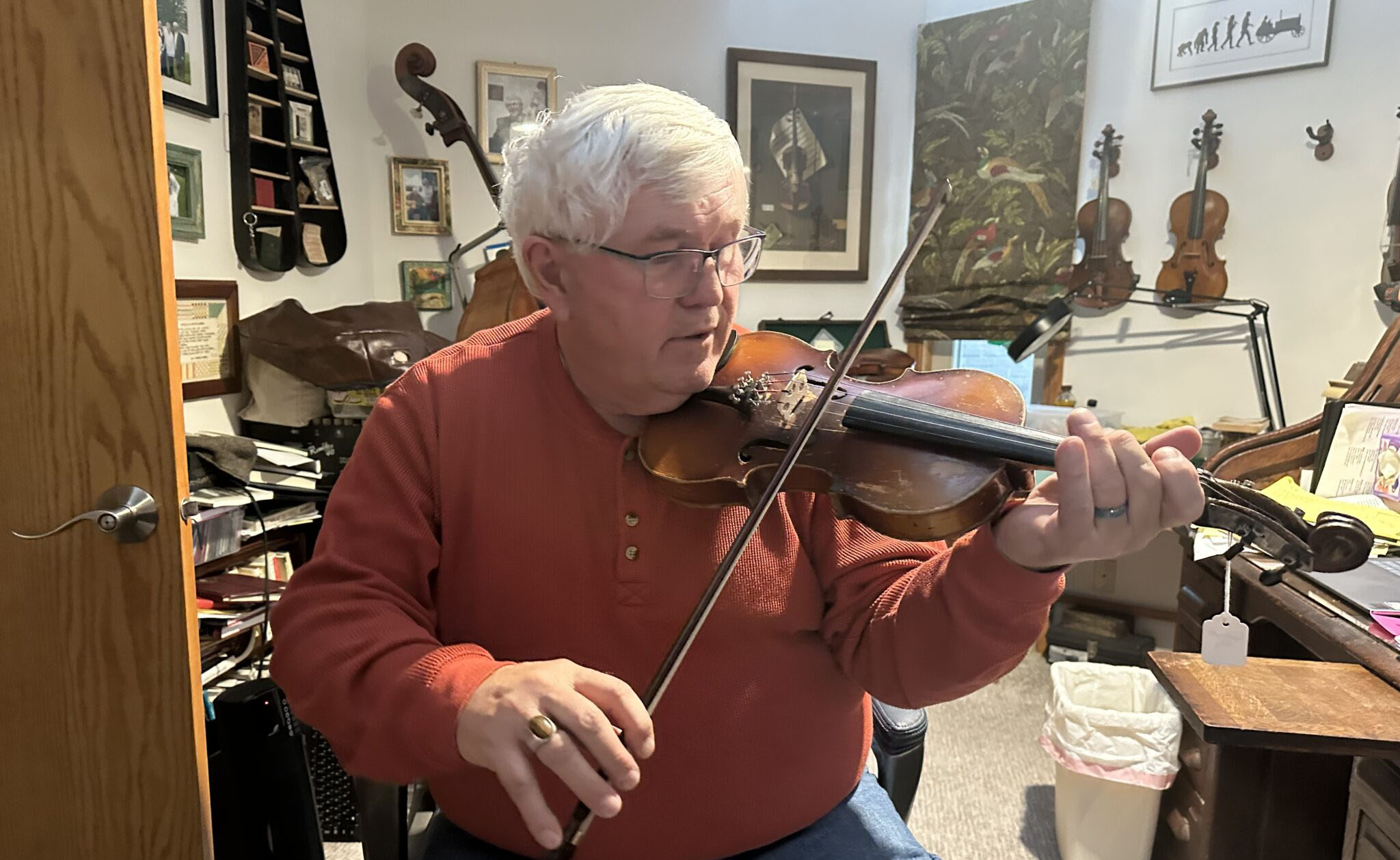
Violins are found in shops, flea markets and on Facebook Marketplace, and even in pieces they can be useful. An electric violin Lasley said he was unable to fix hangs as an art piece on his office/workshop door and instruments both in need of repair and all fixed up are on the walls, a bucket of old bows in the corner and cases not fit for use set against the wall.
Lasley buys new bows and cases for the instruments before they’re donated, he said, so students can have new materials that can take the beating often provided by young musicians.
Each violin has its own work that needs to be done, Lasley said, and no two violins are the same. They each have their own history, told through the dings and etchings on the wood that Lasley said he keeps if they have a particular meaning, like the “DMPS,” standing for Des Moines Public Schools, he found on a fiddle he’s already donated.
Lasley said his hobby was born from woodworking, a lifelong hobby he spent more time on after retiring. There are only so many pieces of furniture friends and family can accept before there isn’t any room for more, he said.

One violin he’s yet to start on has come apart, with the top completely separate from the back and evidence of previous repairs that need to be fixed. Lasley said he’ll start the project by scratching off old glue, patching cracks and gluing the top plate back on. Once the front has been reattached, Lasley will insert a soundpost that, once restrung, will be held in place by 55 pounds of pressure.
Before he restrings it, however, Lasley said he’ll have to shape a bridge and attach it to the face of the violin to hold the strings.
“You end up doing everything while eyeballing and measuring, and then I get frustrated. That’s when I come over here and practice,” Lasley said, gesturing to another corner of his office where a music stand is set up, sheet music laid out.
Playing on
Lasley started playing violin when he was 69 years old. Now 73, the retired professor said he mainly learns by listening to recordings of his teacher playing over and over until he’s got the tune in his head and can sing it out on the strings. He emphasized that while he — and his teacher — can both read sheet music, this is his preferred learning style.
Holding the violin owned by his great-grandfather, who died in 1922, Lasley wondered if the melodies he plays on it were made more than a century ago on the same instrument, 30 years before he was born.
Lasley was lucky, he said, to have grown up with music constantly in the background — guitar from his father, upright bass from his mother and a reed pump organ he remembers playing at 4 years old with his grandmother, who had to push the pedals since his feet couldn’t reach.
In addition to playing the clarinet, Lasley said he played the bass clarinet and saxophone in school and played upright bass in his own band for years.
As he continues to search for fiddles to make sing once again, with the goal of getting them in students’ hands, Lasley said he hopes they help to instill values of paying kindness and generosity forward.
“It’s about helping the next generation,” he said.