


By Anelia K. Dimitrova
It took a century and a half of history and happenings to get from the founding of the University of Northern Iowa in 1876 to the morning of Oct. 4, 2025, when Panthers marched in Cedar Falls boasting their purple pride.
Saturday morning was the time and downtown was the place for this generation of students, faculty and staff to claim, deservedly, their place in history by being a part of the parade. Themed “Panthers Through Time,” the parade showcased creatively constructed and festively decorated floats from UNI departments, student organizations and community businesses, all echoing the anniversary motif.


Since its inception, the parade has been a core part of the university’s Homecoming activities, with some exceptions.
It has come a long way from its inaugural kickoff in October of 1925, when the very first parade was held on campus during the third Homecoming activities of what was then Iowa State Teachers College.
On Saturday, Panthers prowled through the parade, steeped in purple, pomp and pride as part of a year-long celebration of UNI’s 150th birthday.
At every corner, literally, the floats were greeted with cheers, applause, laughter and yes, kids filling up their plastic bags with candy, stickers and small flags.


The connectedness between the students and faculty, who represented their respective programs through the floats, and the spectators, many of whom sported purple and gold attire, was palpable in the cheers, the singing, the dancing, the clapping and the hectic snapping of video clips and still photos, seeking to capture memories from the parade.


For those who were present in person, being a part of the “Panthers Through Time” parade was an unforgettable and unrepeatable bonding experience.
That experience will get even more precious with time, as those who have lived through special memories would attest.
The 2025 parade also demonstrated the embrace between the city and the university.
It is often that city leaders mention, in public remarks, that Cedar Falls would not be what it is today had it not been for the university. And just as often, university leaders say that UNI would not be what it is now without the support of the city over the years.
The parade sealed that message with its organic energy, pride undergirded with passion and shared joy.

At 11 a.m., UNI Public Safety Officer James Dally turned on the lights on his squad car and activated the siren in a short burst, signaling the beginning of the parade.
Behind him, UNI ROTC members carried the flags.
A blue sky, a hair-ruffling wind and the mercury hovering in the high 80s Fahrenheit served as a propitious backdrop to the event.
It took roughly 90 minutes to tell the story of UNI’s past, present and future in floats and music.

The work of past leaders had provided the foundation for the university, visible in such floats as the campanile, and in the many alumni packing the sidewalks. The present, too, was secured by new programs like nursing and by the solid number of students who this fall, for a second year in a row, numbered over 9,200. And then the future: that, too, looked bright. The presence of young Panthers, some still in their mothers’ arms, others running around to grab candy during the parade, held that promise.
The route started at the intersection of Ninth and Main streets, then wrapped up around Second Street, ending at River Front Plaza.
How UNI’s Homecoming parade got its start
The history of UNI’s Homecoming celebrations and the parade reads like a reflection of the times through which the university, the city, the community and the country as a whole had journeyed.
It is easy to track it today online thanks mainly to the efforts of the campus newspaper, now called the Northern Iowan, but earlier called The College Eye. It is important to note that student journalists wrote the first draft of campus history. It is because of their dedication to cover Homecoming activities on the news and opinion pages of the newspaper, that in 2005, UNI archivist Gerald L. Peterson and his fellow researchers were able to create an outline of UNI’s Homecoming history.

The first Homecoming celebration took place on Oct. 30, 1922, and the first parade became a part of the festivities in October of 1925, according to The College Eye records, cited by Peterson.
“It is unclear exactly what was in the parade, but several rough notes indicate that at least some students in the parade lampooned their professors,” the history reads.
In its first years, the parade took place on campus and its duration was rather short, but in 1929, its route expanded, going from College Street to 18th Street, to Main Street, and onto First Street.
The very next year though, during the 1930 Homecoming, the parade returned to campus, according to records.

Homecoming was not celebrated during 1943 and 1944 because of World War II but in 1947 the parade was reinstated and that year, 13 floats took part in it on campus.
Even though the parade has not always been a part of the Homecoming activities, and its route has changed over time, it holds a special spot in UNI’s Homecoming traditions.
“Would alumni from 1925 recognize Homecoming today?” Peterson asks rhetorically in the conclusion of his history overview, which was last updated in 2020. “They would recognize the parade, though they might be surprised at its long route and at some of the float themes.”
The 2025 Homecoming parade: Panthers Through Time
It’s always fun for a community journalist to walk through the streets before the parade and talk with participants.
Like performers waiting to get on stage, the float makers find it hard to contain the adrenaline as they await the start of the event. Improvised chats at that time are always fruitful writing material as knowing the people behind the parade makes it real.
It’s also a great opportunity for portrait photos.


I first stopped by the float of the Northern Iowan, which I work with, along with my colleague, Chris Martin. As I lined the students up for a commemorative photo in front of the golf cart decked out with newspapers, none other than President Mark Nook appeared out of nowhere and photo bombed the picture in jest. Much to everyone’s delight, he then posed with the students for a “Go Cats” photo.

I then met Nicholas Billings and HtooHtoo Wah, students from the Construction Management program, who told me about their float. It featured a UNI birthday cake, about 11 feet high, big enough to be impressive, but low enough to pass under the power lines, they said. Their platform also had a set of purple and yellow chairs, like the ones found around campus offering welcoming seats for reflection under the trees and in the open spaces. The two chairs next to the birthday cake, though, were fastened to the platform’s floor, so that TC and TK, UNI’s mascots, could wave safely from the float during the parade. (Watch the video below to see how this float traveled through the parade.)
Further down, I heard a beautiful harmony of voices and this is how I met members of the UNI Glee Club. I asked if they would sing another melody, they gladly obliged, performing Jonah’s Song.

I then moved down the street and photographed two other groups of students who waited by their respective floats — the nursing students, who are now growing the recently opened program, and those in the UNI ROTC program, which remains on campus even though its structure recently changed.
Parade dignitaries

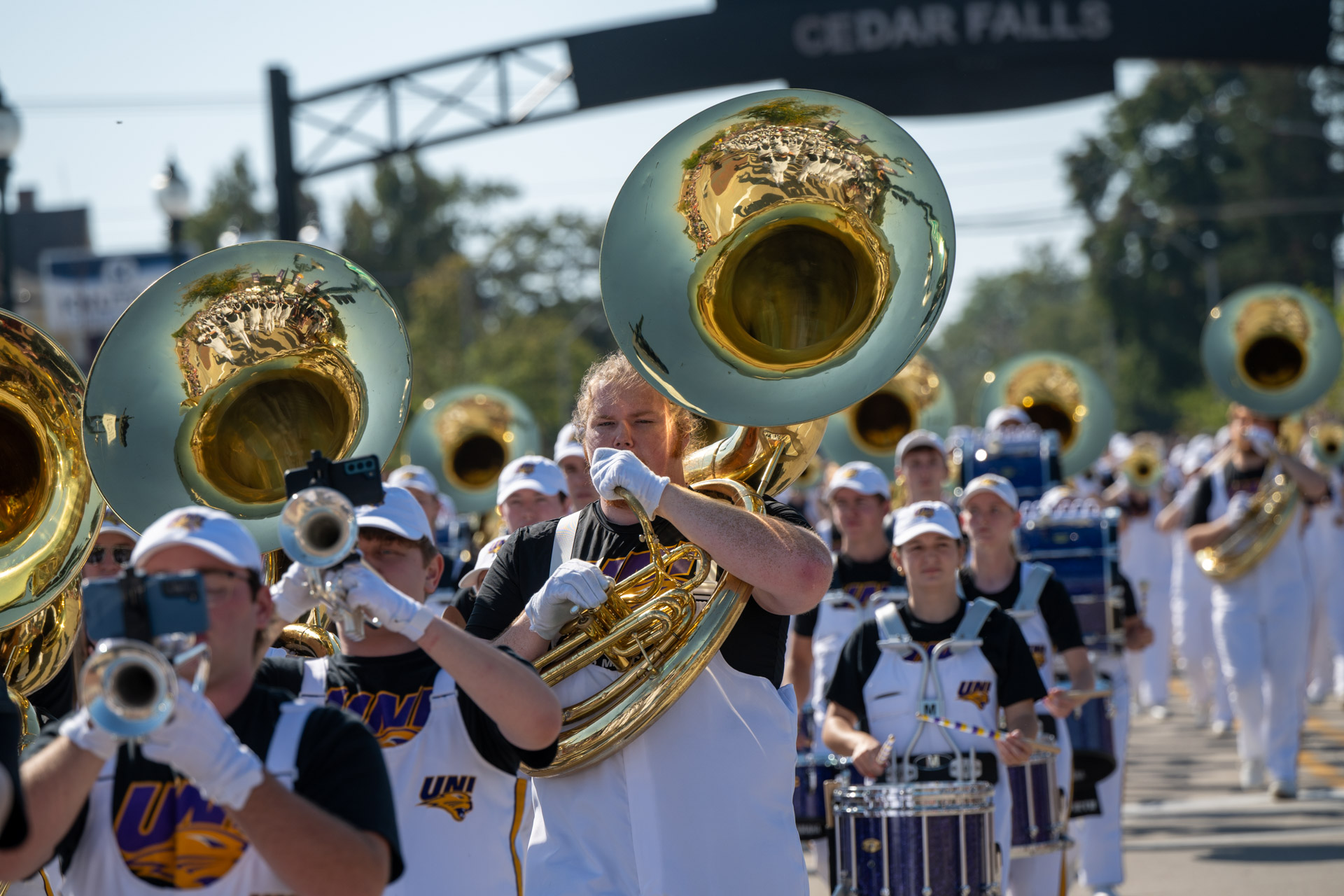
During the parade, UNI’s marching band owned the show. Dressed in white bibs with gold stripes down their sides and wearing black shirts, its members electrified the atmosphere with their spirited performance of the UNI Fight Song and other crowd favorites. The rhythm of their steps measured the march of time like a metronome and the synchrony of their instruments reinforced the importance of unity in human endeavors, prompting many of the spectators to sing along. “U-N-I,” the band members chanted in unison as they performed the UNI Victory Sequence tune. “Go Panthers!”
Emceeing the event were UNI alumni Brad Wells and Nicole (Agee) Carros, both seasoned media professionals. They sat under a tent in the downtown area, narrating the parade, which was also streamed live.

The grand marshal of the parade, Drew Conrad, is a UNI grad and the winner of the 2024 Alumni Service Award. He is now the new executive director of Business and Community Services.
Other dignitaries like Cary Darrah and Randy Pilkington, the co-chairs of the Sesquicentennial committee, UNI President Mark Nook and his wife, Cheryl, Cedar Falls Mayor Danny Laudick and his wife, Jenny, and alumni also rode in the parade.

In addition to university floats, community businesses, like Earl May, took part in the procession as did the Humane Society and some area churches and groups. The 2025 Gold Star Teachers, who are recognized by students, parents and their peers for their outstanding work in the classroom, also participated in the festivities.

Judging by the reaction of the spectators, among the most eye-catching participants in the parade was Bart Schmitz, a program manager at Business and Community Services. He showed remarkable determination and dexterity, as well as endurance as he rolled through the parade route on his skateboard, sometimes in front and sometimes behind a replica of the UNI iconic campanile, which one the Judges’ Choice award.
International students were welcomed as their colorful float passed through the parade route.
Area developer Mark Kittrell, a 1985 physics grad of UNI, was among the many spectators at the parade with his extended family. He is a regular at homecoming events but this one had a special resonance because of UNI’s milestone anniversary.
“The parade was amazing,” he said. “We are always thrilled to see the marching band, the cheer squad, the dancers, the Glee Club, all the students walking in downtown. The international students turnout was exceptional this year. The whole parade was exceptional!”
