


By Brady Reeves
Rain pattered against the metal roof as musicians dried off, caught up with one another and eased into the evening. Some settled into chairs and tuned their guitars, while others warmed up their fingers, eventually forming a circle to introduce themselves to newcomers.
Outside, a summer storm had settled over the Cedar Valley. Inside Steve Klingaman’s reverberant machine shed in Waterloo, the gathering felt somewhere between a rehearsal, a concert and a conversation among friends.
The Cedar Valley Acoustic Guitar Association gathers on the first Thursday of each month for a song circle, giving musicians an informal place to share music, listen to others and try songs in a welcoming environment. Since the COVID-19 pandemic, the circles have been hosted on Klingaman’s property, where the machine shed offered refuge from the evening’s downpour.
The format was simple. The circle made three complete passes, giving each musician three opportunities to share. Afterward, those interested in staying a little longer were invited to participate in an optional fourth round.
I had arrived intending to document the evening, but after years of bedroom rehearsals, and shower rehearsals, if we’re being honest, I was nervously eager to share a few of my favorite covers with a group for the first time.
Around the room, one song and story at a time
Early in the evening, Kris and Bob Brimm shared “L.A. Freeway,” written by Texas singer-songwriter Guy Clark.

Mary Roach performed “Veinte Años,” accompanied by her friend, Dan Nierling, a longtime photographer and photo editor for the Waterloo Courier. Nearby, Nierling’s dog, Rudy, whimpered and anxiously explored the shed as thunder rolled outside.
Between the dog’s nervous whimpers, Klingaman offered some reassurance.
“I’ll shut the thunder off,” he joked.

The comment drew laughter and reinforced the relaxed tone that carried through the evening.
The selections moved across genres and generations. Marie Drilling played America’s “Sister Golden Hair,” Albert Hammond’s “It Never Rains in Southern California” and the Beatles’ “In My Life.” Klingaman shared Gene Autry’s “Sioux City Sue” and “South of the Border (Down Mexico Way)” before later leading the group through Woody Guthrie’s “This Land Is Your Land.”
When my turn came, I began with John Duff’s “House on Fire.” Later, after a string of songs by John Prine, John Lennon and John Denver, I added one more to the mix with Jack Johnson’s “Sunsets for Somebody Else.” Over the course of the evening, I also shared renditions of Dijon’s “Good Luck” and The 1975’s “All I Need to Hear,” while doing my best to sidestep the nerves and remain present, listening intently to the musicians and stories unfolding around me.
It wasn’t just music that filled the evening. Nancy Fransdal told the story behind a guitar she acquired while staying in Montana to be near her sister, who had recently sustained an injury. Fransdal was also recovering from a rotator cuff injury and needed an instrument that was comfortable to play. The guitar was covered in stickers, including one that read, “Be the Light.”
Phil Watson dazzled the group with a reimagined take on Merle Haggard’s “Silver Wings,” making the song entirely his own. Musicians seated around him watched closely as he blended rhythm and riffs of sliding chords that made the guitar sound as if it were weeping. By the end, he had earned a well-deserved “masterful” for his performance from another member of the circle.
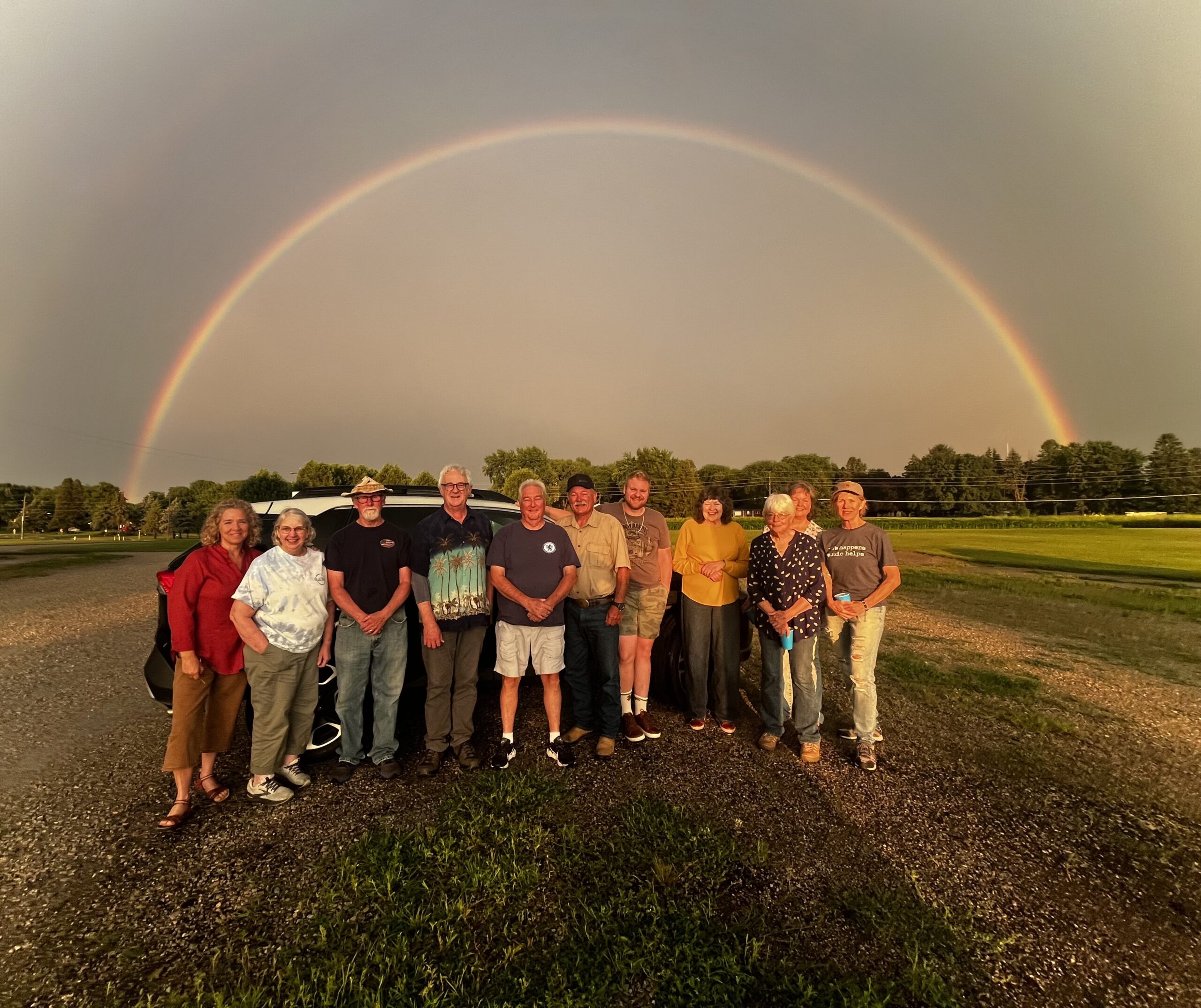
During one of Barbara Dilly’s turns, a crack of thunder startled the group. Several people turned toward the open side of the shed and noticed that the sky had taken on a peculiar amber tone.

A rainbow had appeared beyond the property.
Everyone stepped outside and speculated that one end of the rainbow seemed close enough to touch.
“Yeah, but the pot of gold isn’t on my lawn,” Klingaman quipped.
For a few moments, the song circle paused beneath the glowing sky. The musicians gathered beneath the rainbow, long enough for Nierling to take a picture of the group framed by nature’s color arc.
Later, during the final full pass around the circle, Dilly held up a guitar tha she found at a garage sale and asked whether anyone could help identify it. She was also looking for recommendations for a luthier who might be able to restore it.

The instrument moved through the group as members examined its shape, hardware and worn finish. The conversation reflected another purpose of the song circle. It was not only a place to share music, but also a place to exchange knowledge, seek advice and keep old instruments playing.
The “two Ricks” and roots of the Cedar Valley Acoustic Guitar Association
The gathering felt informal, but the idea behind it began nearly three decades ago with two guitarists who had grown accustomed to playing alone.
Rick Vanderwall and Rick Price, sometimes known within the association as “the two Ricks,” are considered the co-founders of the Cedar Valley Acoustic Guitar Association.
Vanderwall describes Price as a more accomplished guitarist, particularly in the fingerstyle tradition. The two were frequent customers at Bob’s Guitars, where they began talking about their shared love of music and the time they spent playing alone in their basements.
They wondered how many other musicians throughout the Cedar Valley were doing the same thing.
“Wouldn’t it be nice if there was a community or some kind of an event where people who were doing that could regularly get together and share what they were working on?” Vanderwall recalled thinking at the time.
Vanderwall had been considering a trip to New Orleans then in search of music that felt authentic and rooted in the voice of the singer-songwriter. Donny Brazile, his mentor at Bob’s Guitars, suggested he visit the Bluebird Cafe there to experience that kind of songwriting and performance firsthand.
At the Bluebird Cafe, Vanderwall watched three songwriters perform in the venue’s in-the-round format. One of the performers was Don Schlitz, the songwriter behind Kenny Rogers’ signature hit “The Gambler.
Vanderwall loved the way the performers sat together and took turns sharing their work.
“What a great model,” he remembered thinking.
Unlike a jam, where everyone played at once, the format gave each musician space to share what they had been practicing. Vanderwall envisioned “a place where people could trot out what they were working at,” welcoming anyone on the journey of playing or learning guitar to share their progress and connect with others with the same interest.
Vanderwall returned from New Orleans with a souvenir that would not fit inside a suitcase: a model for the musical community he and Price had been imagining. When he shared the concept with Brazile, he offered to sponsor the group by opening Bob’s Guitars to its members after hours.
Vanderwall put out what he described as a “gentle call” and remembers approximately five to seven people attending the first meeting in 1998. Four musicians who attended that first gathering became founding members whose influence has endured throughout the association’s history: Karla Ruth, Charles “Uncle Chuck” Finch, Bob Long and Jovita Long.
Through their continued involvement, talents, leadership and community connections, they helped the organization grow into larger performances, public events and a lasting presence in the Cedar Valley music community.
“It took right off,” Vanderwall said.
The spaces changed, but what grew inside them endured
Vanderwall remembers Brazile being generous with his time staying after hours at Bob’s Guitars. Meanwhile, Vanderwall began searching for other places where the musicians could meet.

Over the years, the association moved through several Cedar Valley gathering places, including Roots Market, the bar at the Olde Broom Factory, the Hub, Spicoli’s Grill & The Reverb Rock Garden and Elm’s Pub at New Aldaya Lifescapes. Of the spaces that welcomed the song circles, Elm’s Pub is the only one still open today.
Locations came and went, but the community nurtured within their walls endured.
Following the COVID-19 pandemic, the group needed a new place to gather. Klingaman stepped forward and offered his machine shed, where members continue to meet on the first Thursday of each month.
As the association grew, donations started coming in. Price helped establish the organization as a nonprofit, and a growing number of members wanted opportunities to perform beyond the monthly gathering.
The association organized a public show at the newly built bandshell in Overman Park. The Hearst Center for the Arts later invited the group to participate in an outdoor summer series held with support from the University of Northern Iowa and Cedar Falls Community Main Street.
Every other Friday during the summer, association members performed before an outdoor movie as part of Movies Under the Moon.
The group also began presenting a yearly winter show at the Oster Regent Theatre.
Vanderwall’s experience in theater helped him organize larger events.
“My role in the organization has always been to coordinate events,” he said. “I was a theater person, so I knew how to put shows together.”
He also credits his wife, Libby, an event coordinator, with helping nurture his ability to organize events through years of mentorship.
The association’s public performances gave its members larger stages on which to share their abilities.
A community of artists
Despite the organization’s name, its gatherings have never been limited by a strict interpretation of acoustic guitar music.
“The hard-and-fast rule about the activity was that there were no rules,” Vanderwall said.
The association was not concerned if someone arrived with an electric guitar or another instrument. Its purpose was not to enforce a particular musical format.
“It’s not a performance,” Vanderwall said. “It’s people sharing music with other people.”
There are no membership dues or formal responsibilities. Those interested in participating only need to email Vanderwall and ask to be added to the mailing list.
The main association gathering takes place on the first Thursday of each month. Bob and Kris Brimm also lead their own version of the song circle, known as the song swap, every other Wednesday at the Cedar Falls Community Center on Main Street.
Vanderwall said Bob Brimm had already been creating opportunities for musicians through open mics before the association formed and has remained instrumental in bringing local players together.
Vanderwall described the Cedar Valley Acoustic Guitar Association as a community of artists and said that, after nearly three decades, he is most thankful for the camaraderie it has fostered.
“There are many little communities within the city like this,” he said. “People get together, do little parades and little gatherings. It’s a wonderful Midwestern kind of thing.”
